
Table of Contents
Flooring: Parquet, Laminate or Tile
A proper flooring comparison starts with price for most people, and that is usually why it ends badly. The difference per square metre may be modest, but one floor lasts ten years and another thirty. This flooring comparison covers the five main options and sets out where each actually works.
In this article
Five floors side by side
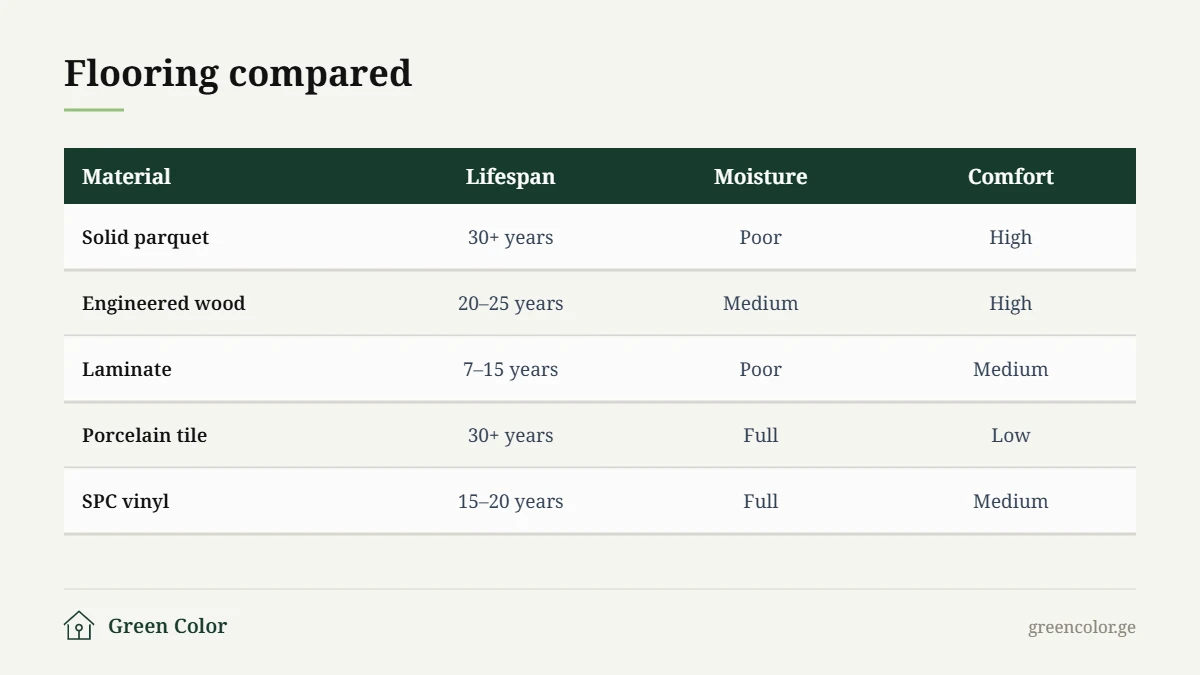
One clarification worth making: the laminate “class” rating — 31, 32, 33, 34 — describes wear resistance, not moisture resistance. Even class 33 laminate copes poorly with water, and a swollen edge never recovers. That is why laminate in a kitchen is a gamble regardless of class.
What works where
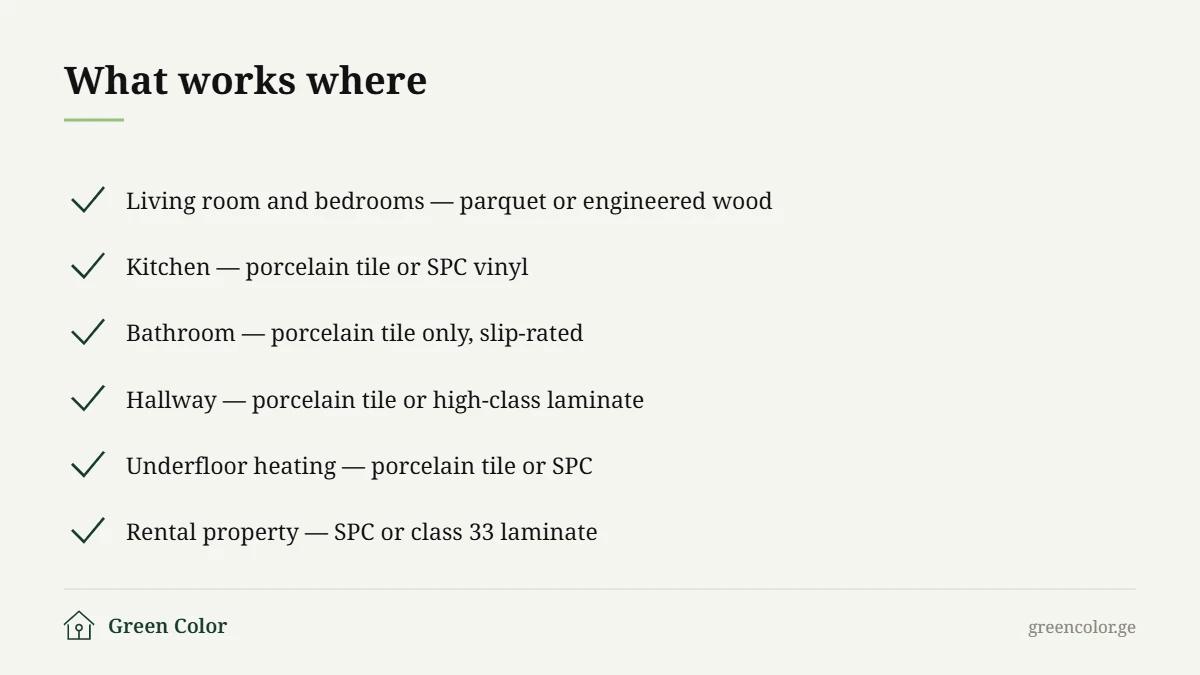
For a rental property the logic changes: what matters is not longevity but repairability. SPC vinyl is the most practical here, because a damaged plank can be replaced without lifting the whole floor.
Underfloor heating
With underfloor heating, thermal conductivity becomes the deciding factor. Porcelain tile and SPC perform best. Solid parquet is the worst choice: wood insulates, and it also moves with temperature, which opens gaps. Engineered wood is an acceptable compromise where the manufacturer explicitly permits it.
Preparation, where floors are actually won or lost
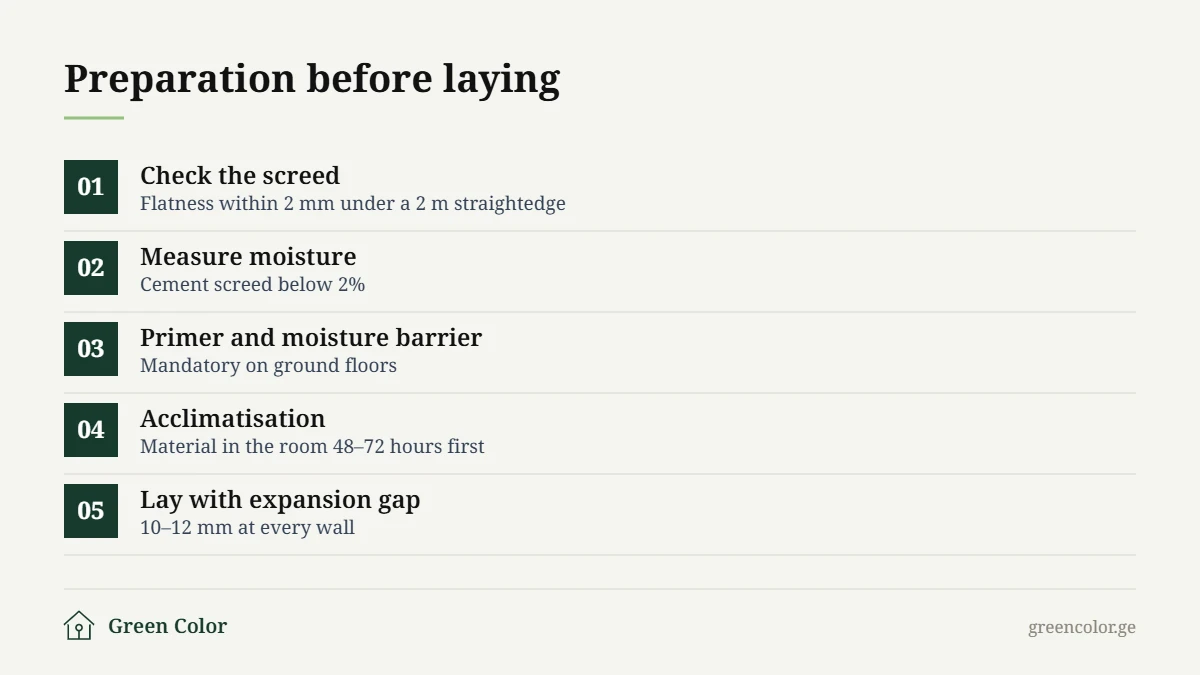
- Screed flatness — no more than 2 mm deviation under a 2 m straightedge.
- Moisture content — below 2% in a cement screed. Parquet laid on a damp base will fail.
- Primer and moisture barrier — mandatory on ground floors and above unheated basements.
- Acclimatisation — material should sit in the room for 48–72 hours before laying.
- Expansion gap — 10–12 mm at the walls. Without it the floor lifts.
The most common defect — a floor that has swollen or lifted — is almost always a consequence of skipping one of these five, not of poor material.
Flooring and screed preparation
Any flooring comparison has to start with the substrate, because a floor is only as good as what lies beneath it. With wood flooring this is especially visible: any undulation in the screed first becomes a noise, then an opening joint.
The technical requirement is a deviation of no more than 2 mm under a 2 m straightedge. Moisture content below 2% in a cement screed, below 0.5% in anhydrite. Both are measured with an instrument and should be recorded at handover.
Drying time is routinely underestimated: a cement screed needs roughly a week per centimetre of thickness, so 5 cm means five weeks. Cutting that period short is the single most common reason parquet fails within a year.
Acoustics and underlay
In an apartment building your floor is someone else ceiling. Impact noise — footsteps, dropped objects — transmits downwards far more efficiently than airborne sound, and underlay is what reduces it.
As a guide: 2–3 mm underlay for laminate and SPC, the manufacturer system for engineered wood, and an elastic decoupling membrane beneath tile to stop cracks propagating from the substrate.
Waste allowance and batches
- Parquet and laminate — 7% waste, 10–15% laid diagonally
- Tile — 10% waste, 15% in large format
- Buy from a single batch; colour varies between batches
- Keep one or two square metres for future repairs
That last point is cheap and valuable: three or four years on, the same model is often discontinued, and a single damaged plank ends up meaning a whole new floor.
Frequently asked questions
How much material should I order?
Add a waste allowance: 7% for parquet and laminate, 10% for tile, 15% for diagonal laying. Keep one or two square metres in reserve for future repairs, because batches change and the colour will not match exactly.
Solid or engineered wood?
Engineered is more stable against humidity swings and works better over underfloor heating. Solid lasts longer and can be sanded several times. In the Tbilisi climate, where humidity shifts seasonally, engineered is the more practical choice.
What does laying cost?
Labour varies with the material and the complexity of the layout. For a figure on your own property use the renovation calculator.
For related decisions see our guide to interior design principles, and our completed projects.