
Table of Contents
Plumbing in an Apartment: Pipes, Falls and Pressure
Apartment plumbing is concealed work, like electrics — a mistake only shows once the wall is closed and the tile is laid. The difference is that a plumbing mistake usually appears on your neighbour ceiling. This guide covers pipe types, falls, pressure and the rules that allow no compromise.
In this article
Pipe types
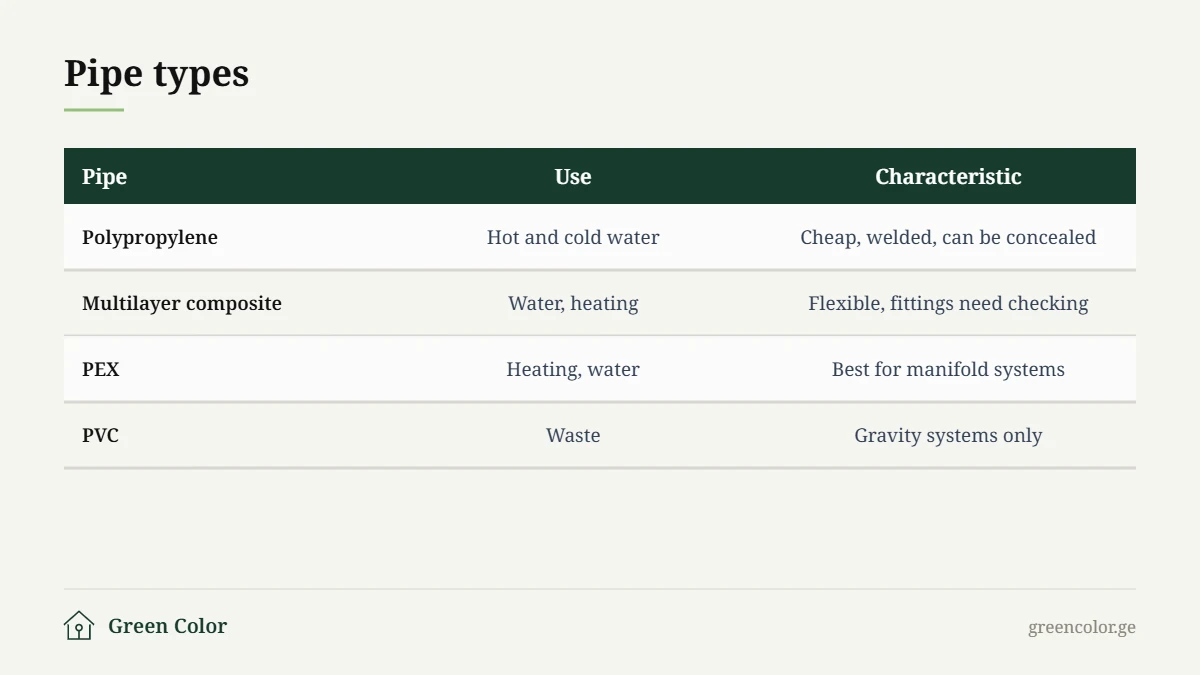
Polypropylene is the most common choice in Georgia — inexpensive, and a welded joint is reliable when made correctly. Its weakness is precisely in the welding: an overheated joint narrows internally and restricts flow, and nothing about that is visible from outside.
A manifold arrangement, where a separate pipe runs from one distribution point to each appliance, costs more but keeps pressure stable and puts no joints in the concealed sections — which means no potential leak points either.
Waste falls
This is where mistakes are most common. A 50 mm pipe needs a fall of 3 cm per metre, a 110 mm pipe 2 cm. Less and solids settle and the pipe gradually blocks. More is also a problem: the water runs away too fast and leaves solids behind.
This is the real constraint when moving a kitchen. Over four metres a 50 mm pipe has to drop 12 cm, which usually means raising the floor.
Non-negotiable rules
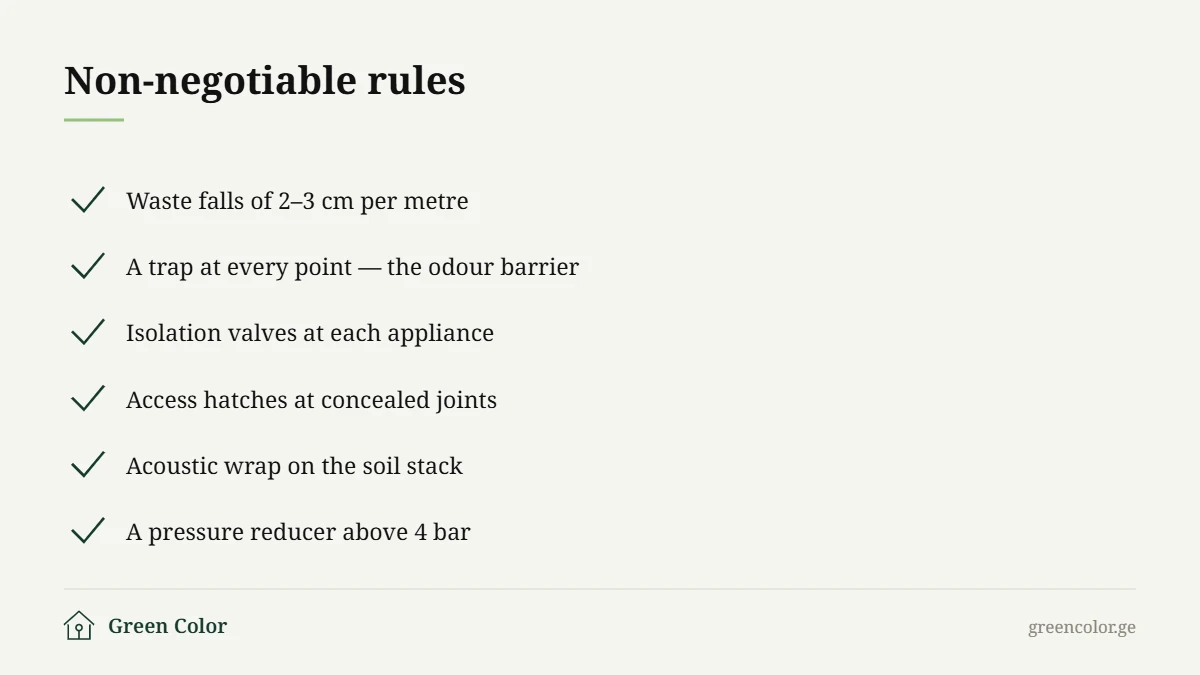
- Falls of 2–3 cm per metre depending on pipe diameter
- A trap at every point — it is the odour barrier, not decoration
- Isolation valves at each appliance, so a fault does not mean shutting off the whole flat
- Access hatches at every concealed joint
- Acoustic wrap on the soil stack, especially in a wall adjoining a bedroom
- A pressure reducer where incoming pressure exceeds 4 bar
The pressure test people skip
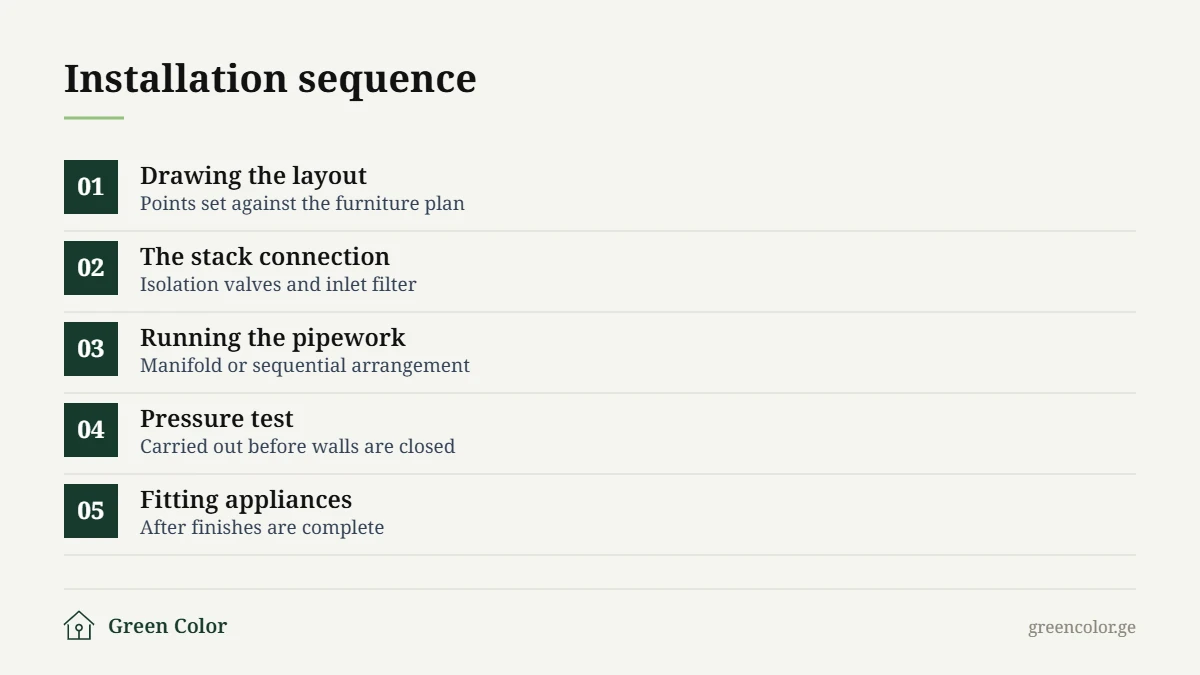
Before the walls close, the system should be pressurised to at least 1.5 times working pressure and left for anywhere from two to twenty-four hours. If the pressure holds, the joints are sound. That one procedure is far cheaper than lifting tile six months later.
Why pipework knocks
Three usual causes: high pressure, solved by a reducer; water hammer when a solenoid valve closes quickly, solved by an arrestor; or a pipe in direct contact with the structure without proper clipping, which turns the wall into a sounding board.
Pressure and water hammer
Apartment plumbing depends on pressure in two directions: too little harms comfort, too much harms the system. Standard plumbing practice puts optimum working pressure at 2–4 bar. Above 5 bar, joints and tap mechanisms wear at an accelerated rate.
Water hammer is a separate phenomenon. When the solenoid valve in a washing machine or dishwasher snaps shut, the flow stops instantly and a pressure wave forms in the pipe. The knock you hear is that wave striking the pipe wall.
The remedy is an arrestor — a small air chamber that absorbs the wave. It is fitted close to the appliance connection and costs very little. Without one, every cycle degrades the pipework slowly but steadily.
Material compatibility
One technical detail that often gets ignored: joining dissimilar metals directly accelerates corrosion. A copper pipe connected straight to galvanised steel forms a galvanic couple, and the steel deteriorates within a few years.
The solution is a dielectric union — an adapter that electrically separates the two metals. In an older flat, where new copper or polypropylene runs meet an old steel riser, that junction is the critical one.
What to verify before sign-off
- A pressure test certificate recording the pressure and duration
- Each isolation valve operated individually
- Access hatches still reachable after furniture is installed
- An arrestor present on the washing machine line
These four items rarely appear in an estimate, yet they decide whether apartment plumbing lasts a decade without intervention.
Frequently asked questions
What does plumbing cost?
In Georgia, first-fix runs roughly 10–15 GEL per point plus materials. A typical flat has eight to twelve points — kitchen, bathroom, WC and washing machine.
Concealed or exposed pipework?
Concealed looks better; exposed is repairable. The usual compromise: conceal only continuous runs with no joints, and keep every joint behind an access hatch or in the open.
How long does it take?
First-fix for a standard apartment takes three to five working days, plus the pressure test period.
For wet-room detail see our guide to bathroom renovation, and for costs the renovation calculator.