
Table of Contents
10 Common Renovation Mistakes and How to Avoid Them
Across a decade of projects, renovation mistakes are almost never original — the same ten things repeat from site to site. The good news is that every one of them is avoidable in advance and costs almost nothing to prevent. The bad news is that correcting them is always expensive.
In this article
The ten mistakes
- Choosing materials after work has started. Tile, flooring and sanitaryware dimensions dictate where services run. Choose first, then begin.
- Budgeting with no contingency. Strip-out in an older flat almost always uncovers something. A 10–15% contingency is mandatory.
- Paying by calendar. Payments should attach to stage handover, not to dates, or you lose all leverage.
- Agreeing variations verbally. Every additional item needs to be recorded in writing, with price and programme adjusted.
- Economising on waterproofing. In a wet room this is the one saving that shows up on your neighbour ceiling.
- Planning sockets without a furniture drawing. The result is a switch behind a wardrobe and extension leads everywhere.
- Laying flooring before painting. The finish is either damaged or covered and damaged anyway.
- Skipping photographs of concealed work. You will remember this the first time anyone drills a wall.
- Laminate in kitchens and wet areas. The class rating covers wear, not moisture. A swollen edge never recovers.
- Ignoring ventilation. Airtight windows plus a weak extractor equals mould, reliably.
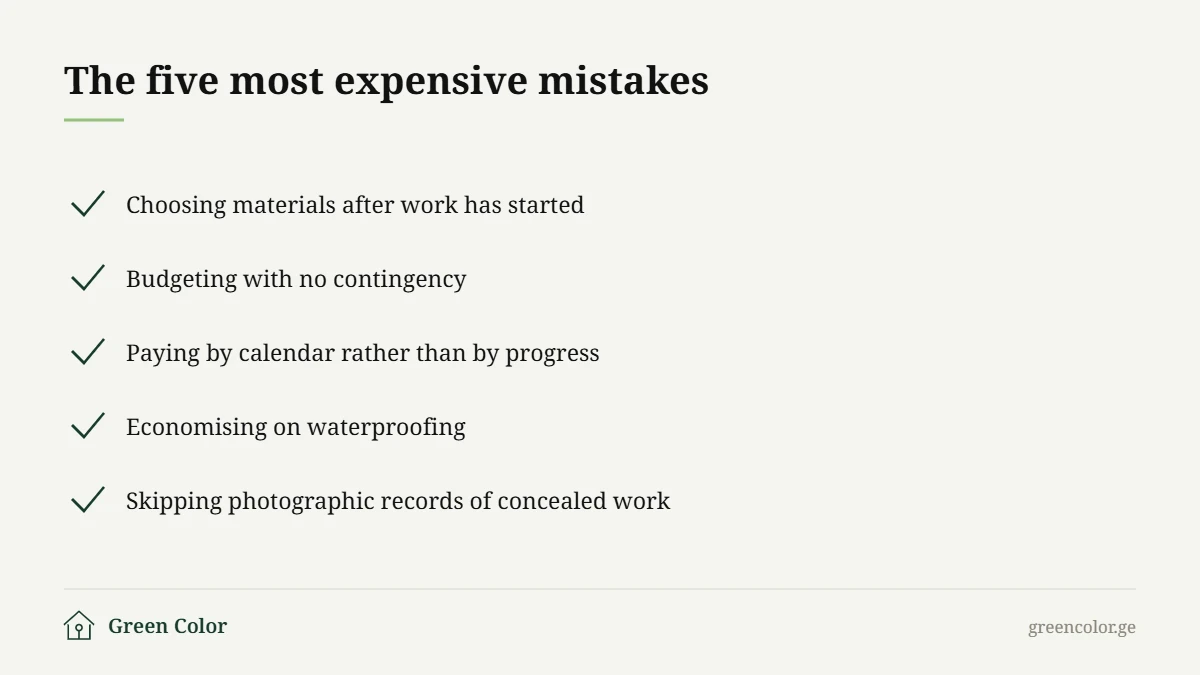
The five most expensive
What correction costs
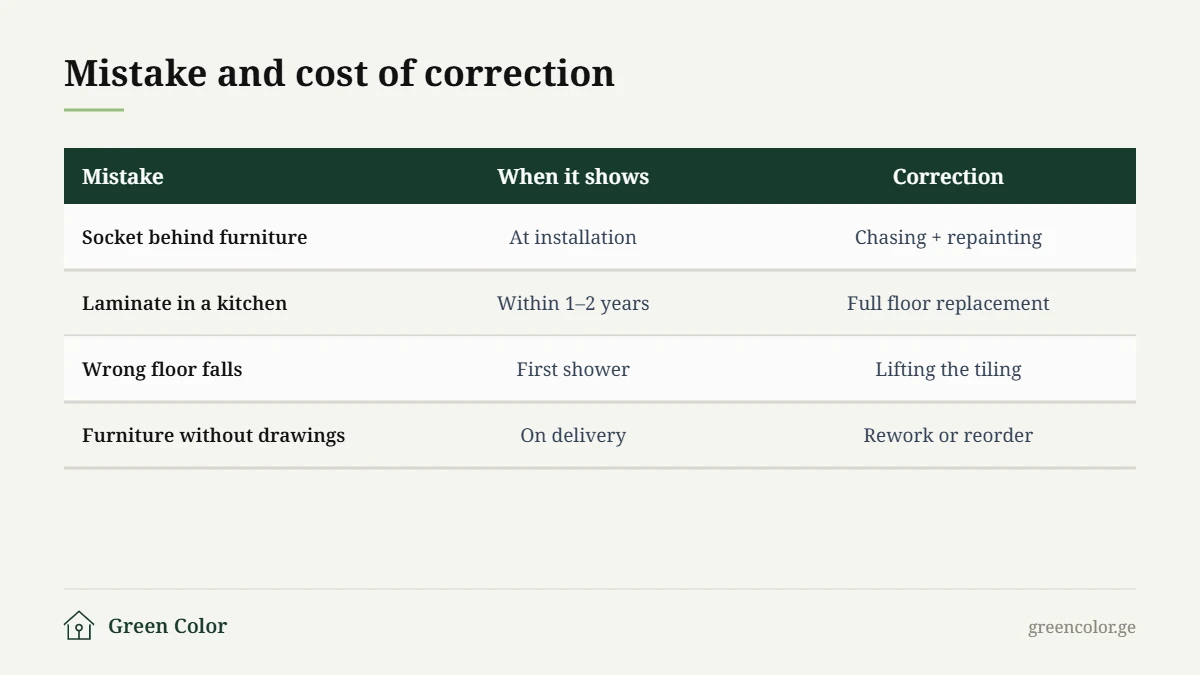
Look at the middle column. Most mistakes do not appear during the work but later — at furniture installation, at the first shower, in the first winter. That is precisely why “it looks fine” is not an adequate acceptance criterion.
Four habits that prevent most of it

- Decide in advance — materials and appliances chosen before strip-out.
- Write everything down — variations in writing, with price and time.
- Photograph everything — every concealed junction before the walls close.
- Pay against progress — on stage handover, not on a date.
All four are free. The only thing they require is discipline — and that is what separates a project that lands on time and on budget from one that does neither.
Why renovation mistakes repeat
Renovation mistakes are almost always systemic rather than accidental. The most common structural cause is that decisions get made at the moment the work is already underway — under time pressure and on incomplete information.
The second cause is fragmented responsibility. When the trades, the designer and the supplier are not connected, each does their own part correctly, but nobody owns the junctions where one trade meets another. Most defects appear precisely at those junctions.
The third is a lack of documentation: a decision that exists only verbally will inevitably be distorted during execution.
The acceptance procedure as the final filter
International practice has a tool for this called a punch list: before handover, a schedule of defects is drawn up which the contractor must remedy before final payment. That single document resolves most disputes.
In practice it means the property is inspected in detail, every observation is recorded with a photograph and a number, a remedy period is agreed, and the final instalment is released only once the list is fully closed.
Mandatory inspection points
- Walls under raking light — checking for ripples and scratches
- Wet areas — water running to the drain from every point
- Electrics — every socket with a tester, RCD by its test button
- Doors and windows — full swing, air-tightness, hardware adjustment
- Ventilation — a paper test at every grille
These five checks take an hour. They are what stops the renovation mistakes that would otherwise only surface six months later.
Frequently asked questions
How do I inspect work properly at handover?
Not by eye alone. Check walls under raking light, water running to the drain in wet areas, every socket with a tester, doors and windows through their full swing, and ventilation with a sheet of paper.
What if the mistake has already been made?
Record it in writing with a photograph and date, cite the contract clause, allow a reasonable period for remedy, and hold the next instalment. See our guide to the renovation contract.
Which mistake is the most common?
The first on the list — choosing materials late. On its own it is not costly, but it triggers the rest: the programme slips, decisions get rushed, and errors multiply.
To avoid all of it, start with a proper estimate and a design project. For the full picture see renovation in Georgia.