
Table of Contents
The Renovation Contract: What It Must Contain
A renovation contract is not a formality — it is the only document that means anything once a disagreement starts. In practice most disputes begin not with bad faith but with vague wording: “quality materials”, “a reasonable period”, “standard finishes”. This guide covers the clauses that need to be written down, and is particularly relevant if you are commissioning work in Georgia from abroad.
In this article
Clauses the contract must contain
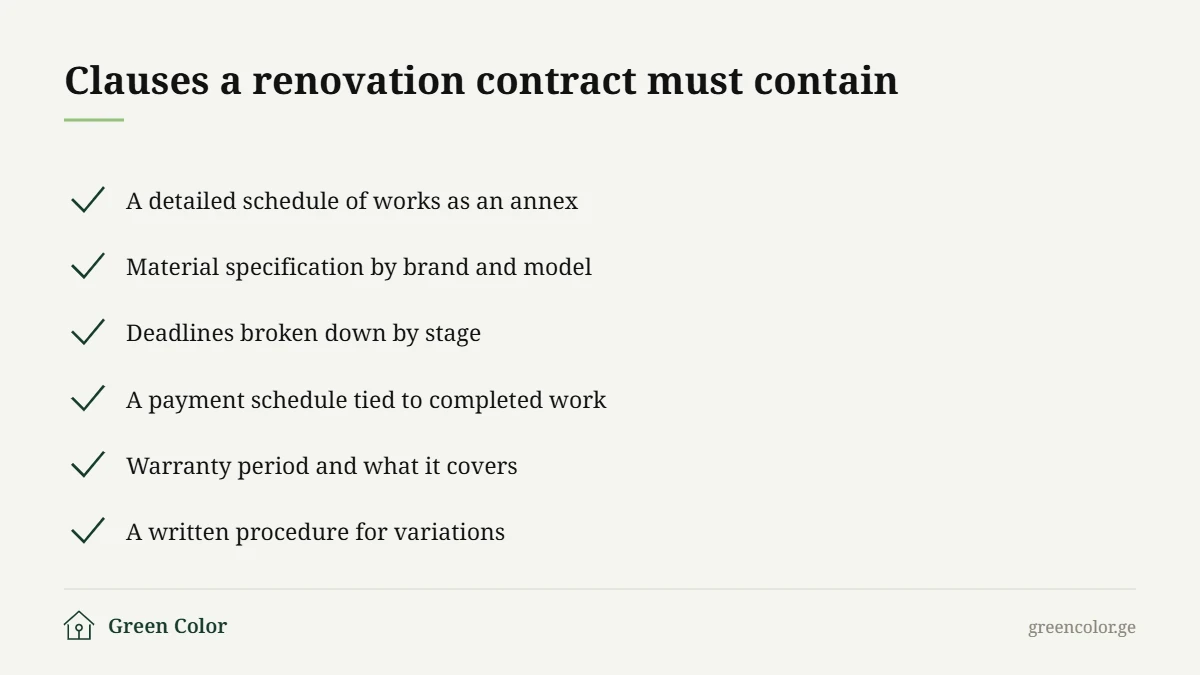
- Schedule of works — as an annex, itemised, with quantities and unit prices
- Material specification — brand and model, not “or equivalent”
- Deadlines by stage — not only a final completion date
- Payment schedule — each instalment tied to a specific stage
- Warranty — the period and its scope, stated separately for finishes and for services
- Variation procedure — any change in writing, with price and timeline adjusted
Payment
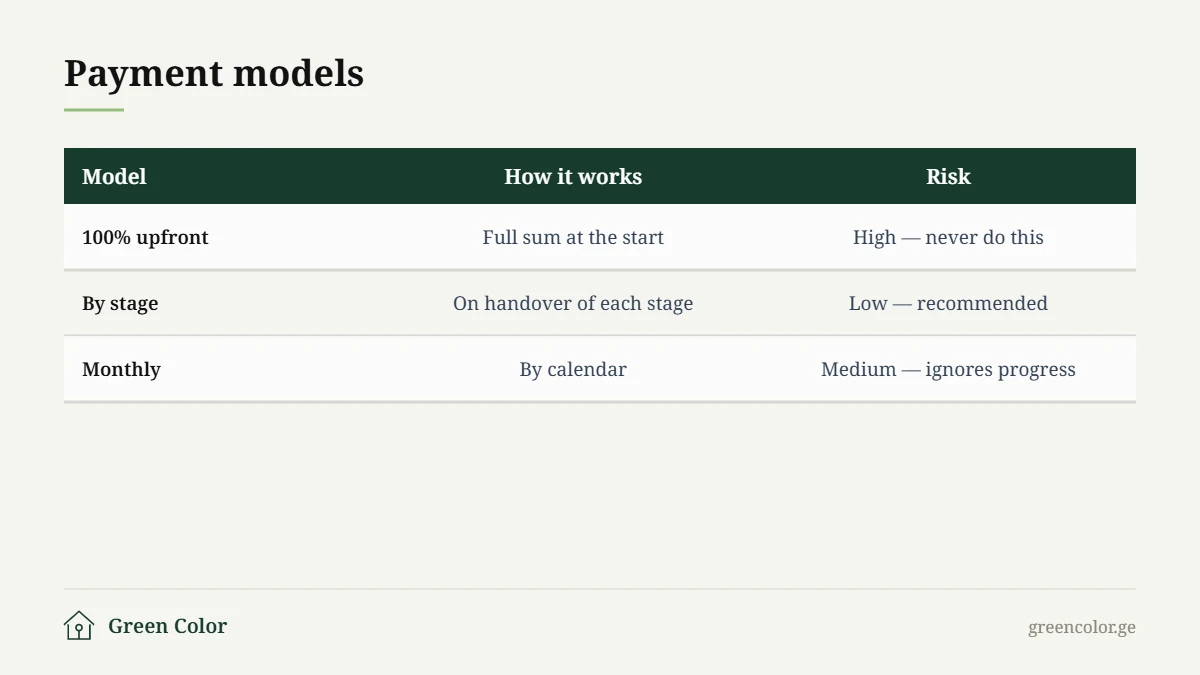
The healthiest arrangement is an advance covering materials, typically 20–30%, followed by payments on handover of each stage. Tying payments to the calendar is the most common mistake: money leaves, work falls behind, and you lose your leverage.
Warranty
The warranty should be written in two parts: finishes, usually one to two years, and concealed services — electrics, plumbing, heating — usually three to five. Concealed work is precisely where defects surface late and cost the most to put right.
Always require photographic records of concealed work: images taken before the walls are closed, showing the routing of services. You will need them the first time anyone drills into a wall.
If the work does not match the agreement
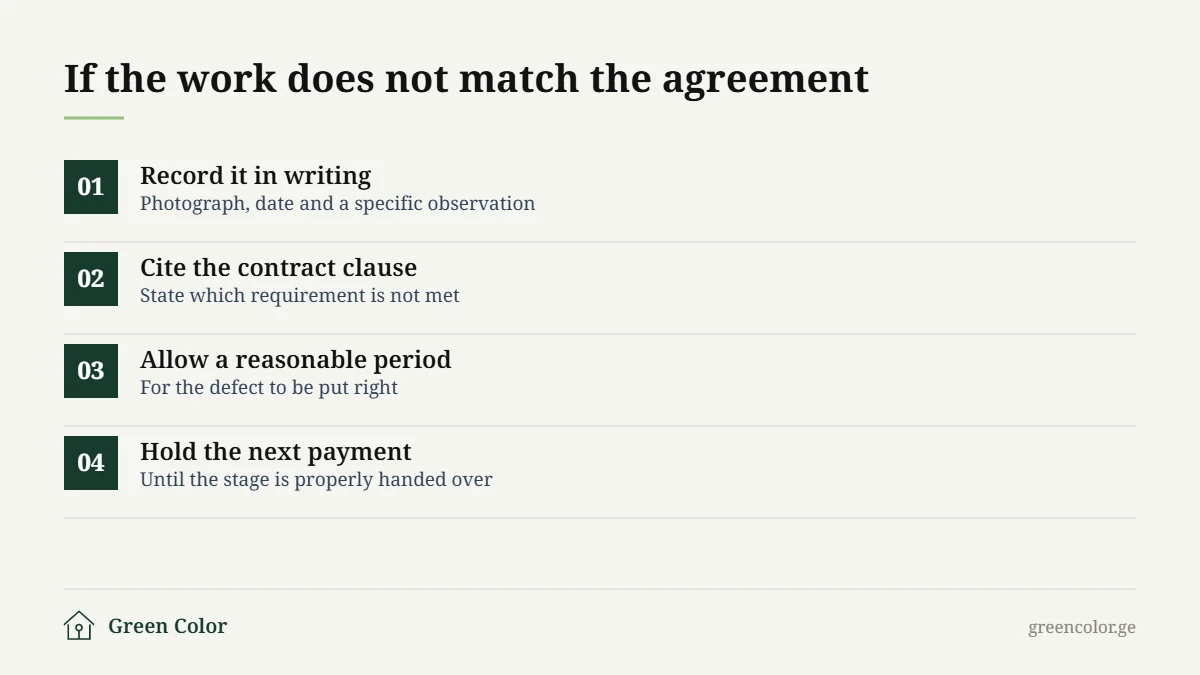
- Record it in writing — photograph, date, a specific observation.
- Cite the clause of the contract that is not being met.
- Allow a reasonable period for the defect to be remedied.
- Hold the next instalment until the stage is properly handed over.
The legal basis of a renovation contract in Georgia
A renovation contract in Georgia falls under the contracting provisions of the Civil Code. In practice that means the contractor carries an obligation to remedy defects and the client an obligation to accept and pay for completed work. The current text is published on the Legislative Herald of Georgia.
One detail matters more than the rest: much of this law is default rather than mandatory, meaning the parties may agree otherwise. That is exactly why the wording of the contract is decisive — anything not written down will be settled by the general rule, and the general rule will not always favour you.
The clauses that generate disputes
In practice most disputes begin with one of three phrases. “Quality materials” with no brand named. “A reasonable period” with no calendar days. “Standard finishes”, which each party understands differently.
All three are fixed the same way: replace the general word with a specific number or name. If a contractor refuses that specificity, the refusal is itself information — a renovation contract like that is not ready to sign.
What should be annexed
- An itemised cost estimate, signed by both parties
- Material specification by brand and model
- A calendar programme broken down by stage
- Photographs of the property in its starting condition
Those four annexes shape how a project runs more than the body of the contract does. The text is the frame; the annexes are the content.
Frequently asked questions
Does the contract need to be notarised?
No. A contract signed by both parties, with its annexes, is sufficient. What matters is that every annex is signed and dated.
What if the scope grows during the work?
That is exactly what the variation clause is for: additional work is agreed separately, with the price and timeline adjusted. Verbal agreement at this point is the single most common source of dispute.
What if I am not in the country?
Specify the reporting format in the contract — frequency of photo and video updates, and who signs off each stage on your behalf. Without that written down, remote supervision depends on goodwill.
Every project we run is governed by a contract and an itemised estimate — see our project management service. For budgeting, read how to estimate renovation costs.