
Table of Contents
White Frame Apartments: What Is Left to Do
A white frame apartment is the most advanced condition in which a developer in Georgia hands over a property. Partitions are up, services are run, walls are plastered and skimmed — it can look as though only painting is left. In practice it is not: the remaining work still accounts for 35–45% of a full renovation budget. This guide sets out what white frame includes and what it does not.
In this article
Three frame conditions side by side
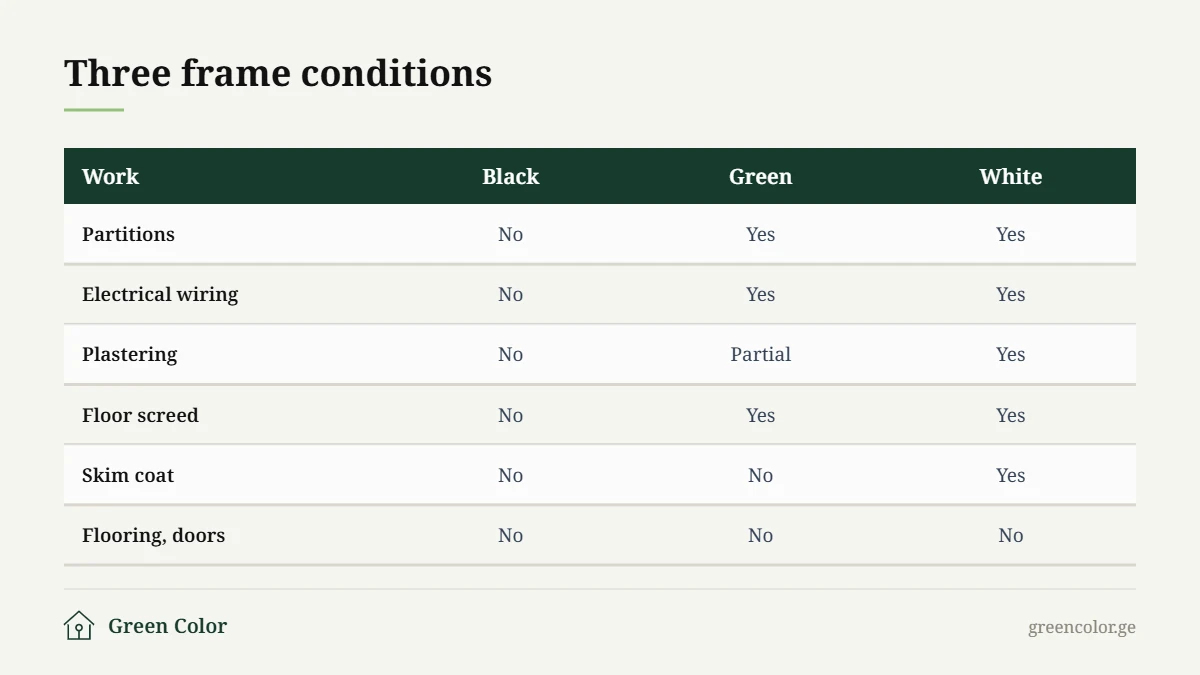
Treat this as a general scheme. Developers in Georgia use these terms inconsistently — some exclude the floor screed from “white frame”, others exclude the skim coat. For that reason the contract should list the actual works, not just the name of the condition.
What remains
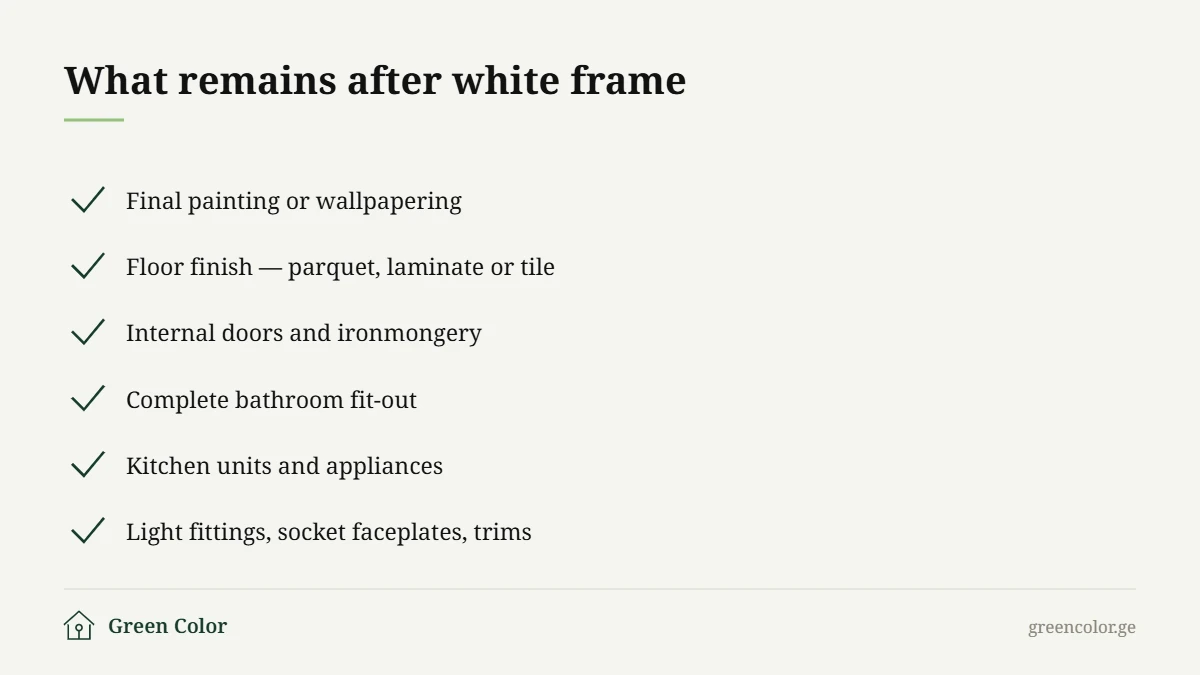
The bathroom is the single largest item — waterproofing, tiling, sanitaryware and ventilation together often come to a third of the remaining budget. Kitchen units and appliances are a separate cost and are normally excluded from a renovation estimate, which is the most common reason final figures come in above expectations.
What to check at handover
- Wall plumb and corners — deviations complicate fitted furniture
- Screed level and cracking — must be corrected before flooring
- Number and position of electrical points — check against the drawing
- Bathroom falls — water must run to the drain
- Ventilation duct flow — test with a sheet of paper
- Window air-tightness — the most common hidden defect
The order of finishing works
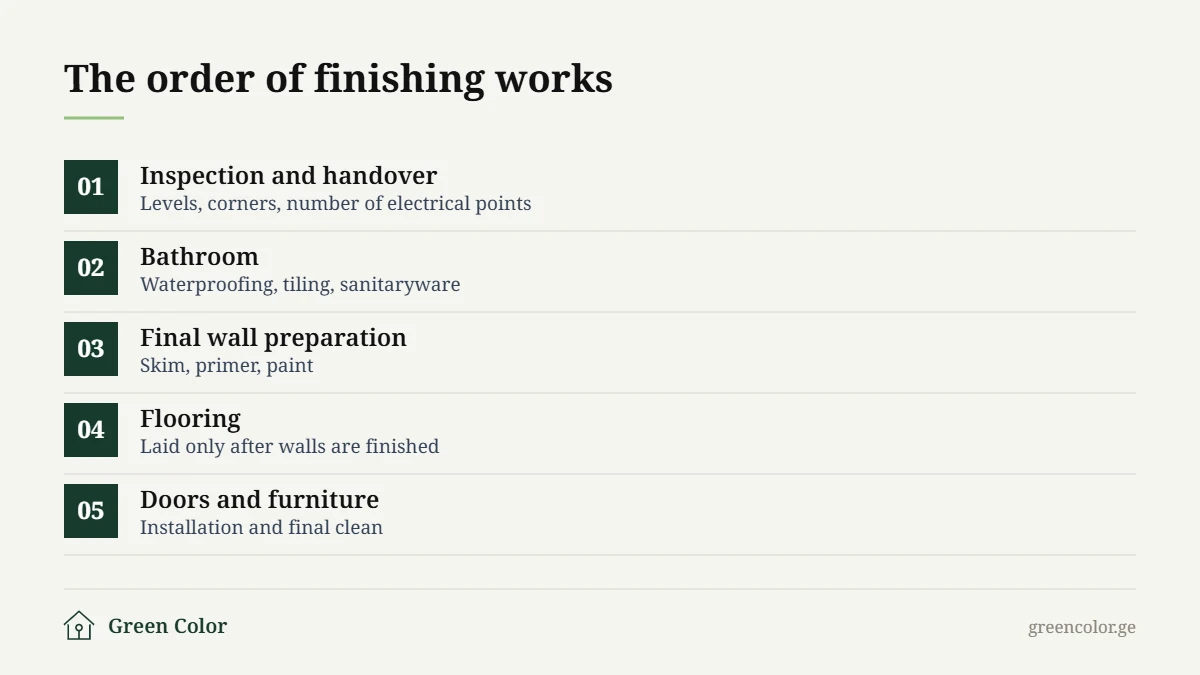
- Inspection and handover — levels, corners, electrical points.
- Bathroom — waterproofing, tiling, sanitaryware.
- Final wall preparation — skim, primer, paint.
- Flooring — laid after the walls are finished.
- Doors and furniture — installation and final clean.
The most frequent mistake is laying the floor before painting. The finish is either damaged or covered up and damaged anyway, and either way it costs twice.
The real budget structure for a white frame fit-out
A white frame apartment commonly overruns because the owner budgets only for “what is left” and keeps furniture and appliances off the list. In practice kitchen units, sanitaryware and lighting often cost as much as all the finishing combined.
The realistic split looks roughly like this: the bathroom takes a third of the remaining budget, floors and walls another third, and the kitchen and furniture the rest. All three blocks need to be costed at once, or the money runs out at the final stage.
What white frame excludes, in detail
Most developers exclude internal doors, floor finishes, sanitaryware, kitchen units, light fittings, socket and switch faceplates, trims and skirtings. Across an average apartment that list adds up to a substantial sum.
Sometimes bathroom tiling is excluded as well, even where the walls are already plastered. The contract should therefore list the actual works rather than naming a frame condition. Track material cost movement through the construction cost index, since these items follow it closely.
Air-tightness and ventilation
In new buildings the windows are airtight and natural air exchange is effectively absent. That property of the building envelope retains heat but raises humidity. In a white frame unit, where the plaster has not fully dried, the problem is especially acute through the first season.
What to do about it
- A timer-controlled extractor in the bathroom and kitchen
- Trickle vents or heat-recovery ventilation in habitable rooms
- A 1.5–2 cm undercut beneath doors for circulation
- Furniture kept 3–5 cm off external walls
These four steps cost almost nothing, yet skipping them is what produces mould in the first winter — and at that point the white frame apartment has to be redone in the corners.
Frequently asked questions
How long does finishing a white frame take?
For 60–80 m², six to ten weeks on average, provided materials have been selected and purchased in advance.
Is a white frame apartment worth buying?
If the standard layout suits you, yes — it saves both time and money. If you want to move partitions, a black frame is the better buy: demolishing a wall that has already been built means paying for it twice.
For an indicative figure use the renovation calculator, or read our guide to estimating renovation costs.