
Table of Contents
Landscaping a Plot: From Drainage to Planting
Landscaping a plot usually comes last in the budget and last in the programme, which is reasonable. What is not reasonable is starting it with no plan at all. The result is paving already laid when someone realises the irrigation pipe was supposed to run underneath it. This guide sets out the correct sequence.
In this article
Order of works
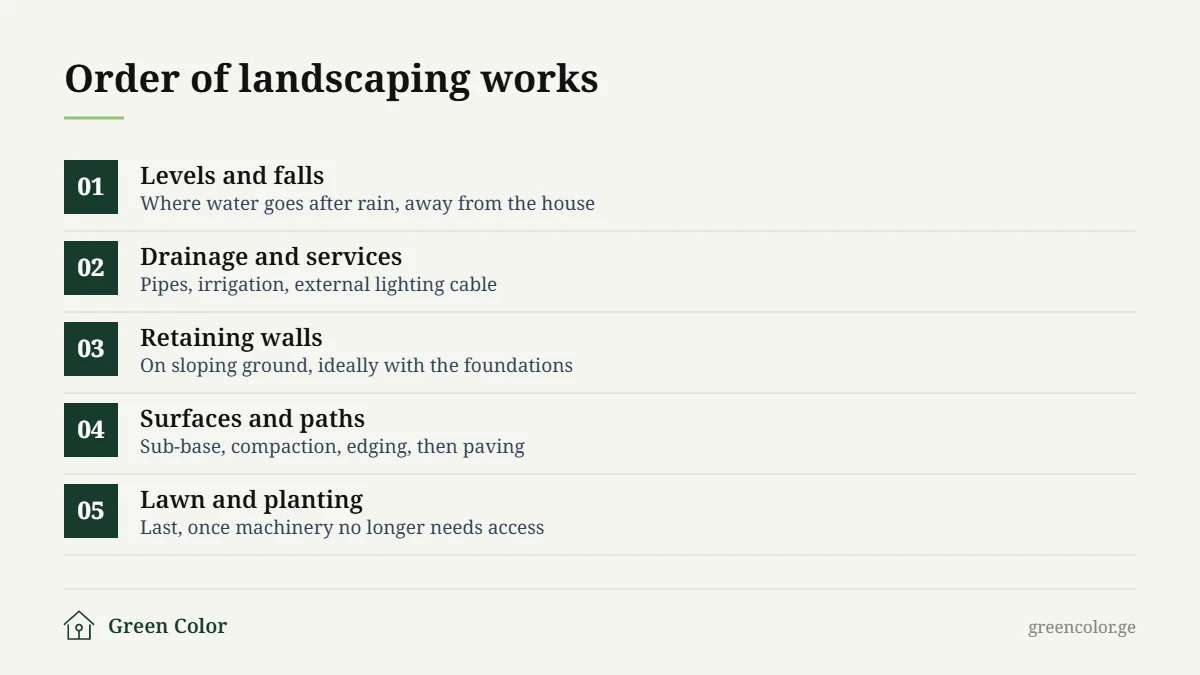
- Levels and falls — where water goes after rain. Everything else follows from this.
- Drainage and services — pipes, irrigation, lighting cable, garage supply.
- Retaining walls — on sloping ground, ideally alongside the foundations.
- Surfaces and paths — sub-base, compaction, edging, then the paving.
- Lawn and planting — only once heavy machinery no longer needs access.
Water is the real subject
Around the perimeter of the house the ground must fall away from the building, at least 2% over the first two to three metres. That single requirement resolves most cases of damp in a basement.
On the clay soils found across much of Georgia water sits at the surface, which makes drainage a necessity rather than an option. The cheapest effective solution is a gravel bed with a perforated pipe, run to the lowest point of the plot.
Path surfaces
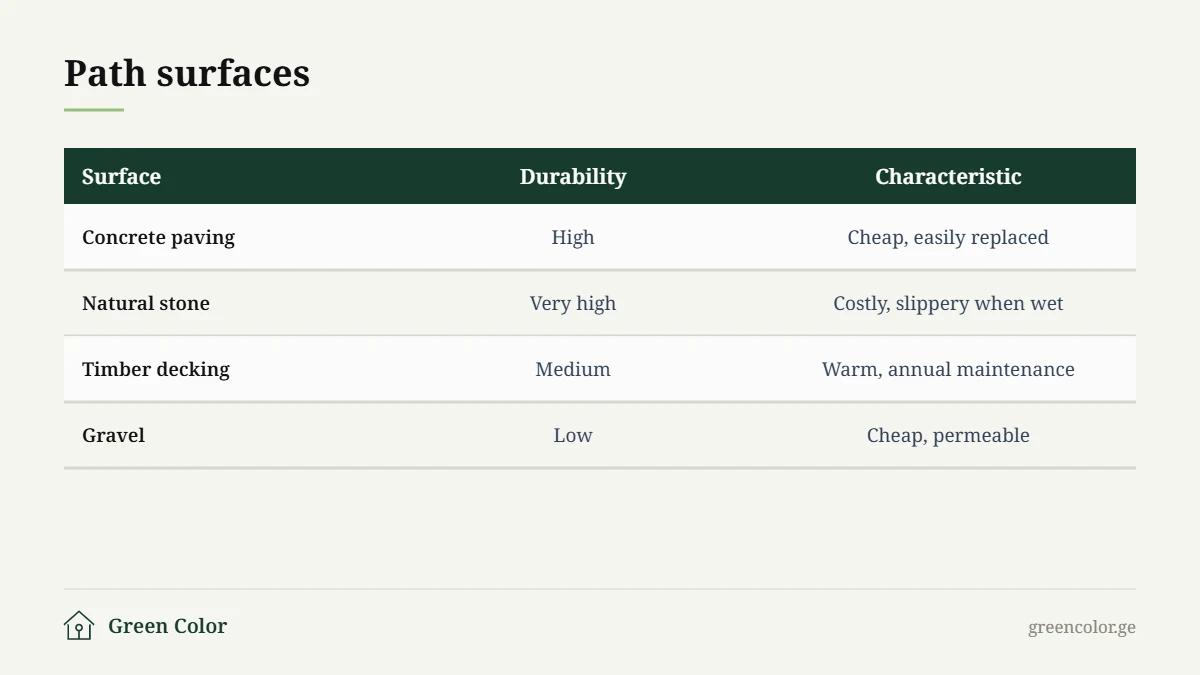
One caution: natural stone is handsome, but a polished surface is dangerous in wet weather — outdoors only sandblasted or tumbled finishes are suitable. Timber decking needs treating annually, a fact that usually becomes apparent only in year two.
Common mistakes
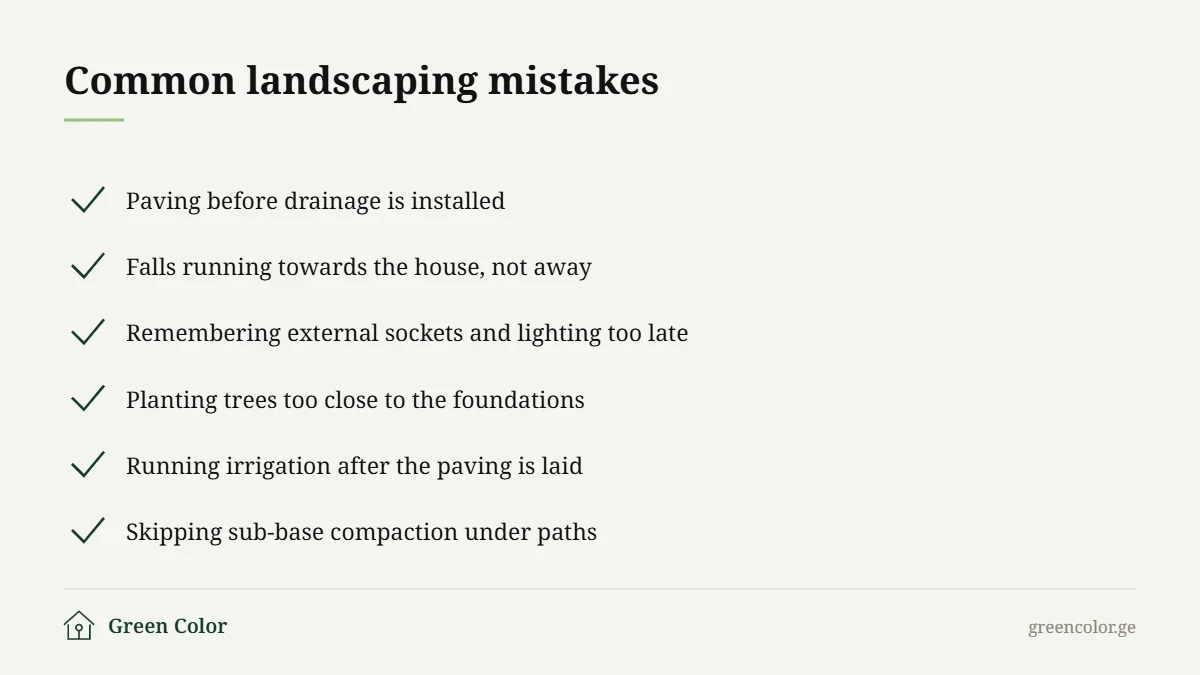
- Laying paving before drainage is installed
- Falls running towards the house — the leading cause of damp basements
- Remembering external sockets and lighting too late, when the route is already under paving
- Planting trees too close to the foundations, where roots work over years
- Running irrigation after the paths are laid
- Skipping sub-base compaction, so the path settles within one season
Budget
As a working figure, landscaping accounts for 5–10% of a build budget. Roughly half of that goes on engineering and sub-base — in other words on what is never seen. That is as it should be: this is the part that decides whether the yard survives more than five years.
Landscaping as water management
Landscaping a plot is essentially an exercise in water management. The principle of drainage is simple: water needs a planned route, or it will find its own — usually exactly where you did not want it.
Two systems exist: surface drainage using channels, gullies and falls, and subsurface drainage using perforated pipe in gravel below ground level. On the clay soils common across Georgia you need both — surface for rainfall, subsurface for groundwater.
The outfall has to be decided in advance: a storm drain, a soakaway or the lowest point of the plot. Drainage with nowhere to discharge simply collects water in one place.
Planting and foundations
Distance from structures is rarely calculated when trees go in. A working rule: plant no closer to the house than half the mature height of the tree. Fast-growing species of the poplar or plane type should not go near foundations at all.
Roots cause damage two ways: mechanically, by lifting foundations and paving, and hydrologically — on clay a large tree draws out moisture, the soil shrinks, and the foundation settles unevenly.
Maintenance, the hidden line item
- Lawn — weekly cutting through the season
- Seasonal commissioning and winterising of irrigation
- Treating timber decking once a year
- Renewing paving joints every three to five years
These costs are almost never included at design stage, yet they decide whether landscaping a plot still looks the part in its third year.
Frequently asked questions
When should landscaping start?
Drainage and services alongside the foundations. Planting and lawn after the building is complete. Everything else falls between the two.
Seed or turf?
Turf gives an immediate result and resists weeds better, but costs three to four times as much. Seed is cheaper but demands attention through the first season. In the Georgian climate, autumn is the best time to lay turf.
Which plants suit the climate?
Native and drought-tolerant species need the least care. Exotic planting requires constant watering through the summer heat, which becomes an annual running cost.
On planning a build see construction in Georgia, and for design costs the architecture calculator.