
Table of Contents
Renovating a Rental Property: Where the Money Is Worth Spending
A rental property renovation follows different logic from renovating your own home. The question is not whether you like it, but how much it raises the rent and how long it takes to come back. This guide covers which items pay for themselves and which are simply expenditure, with investors in the Georgian market in mind.
In this article
Worth it or not
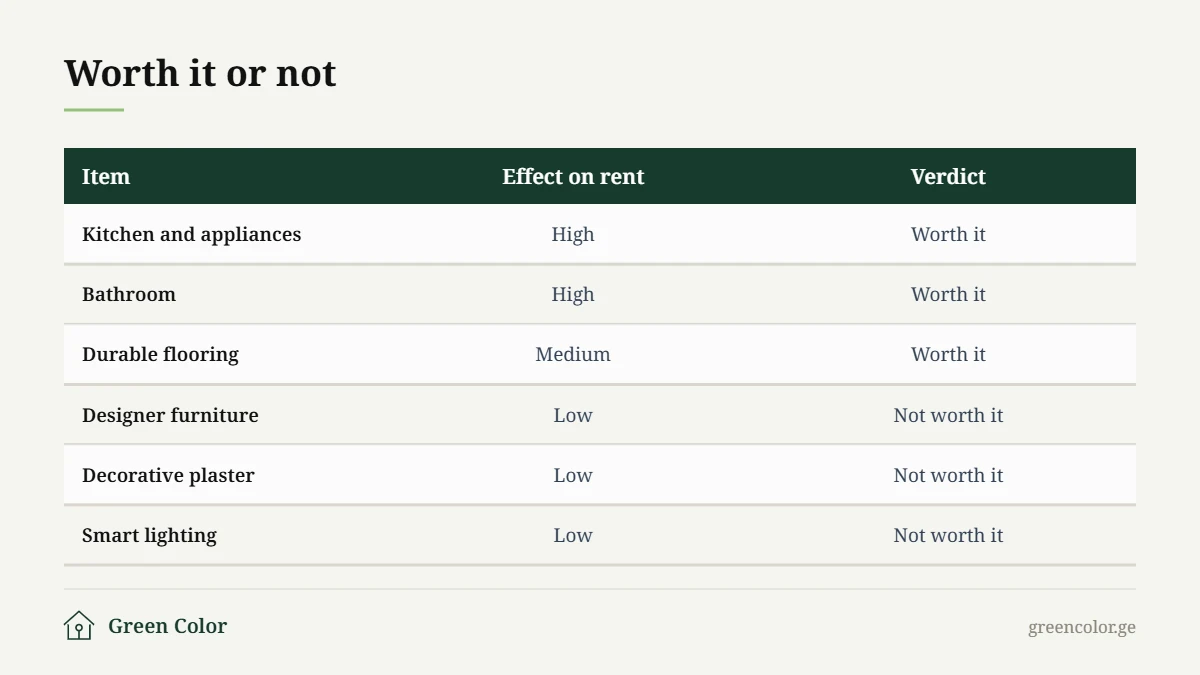
The pattern is simple: tenants pay for function, not aesthetics. A good kitchen and a well-finished bathroom translate directly into rent. Decorative plaster, designer furniture and smart lighting largely do not — they have little effect on the decision and carry the highest risk of damage.
Six principles
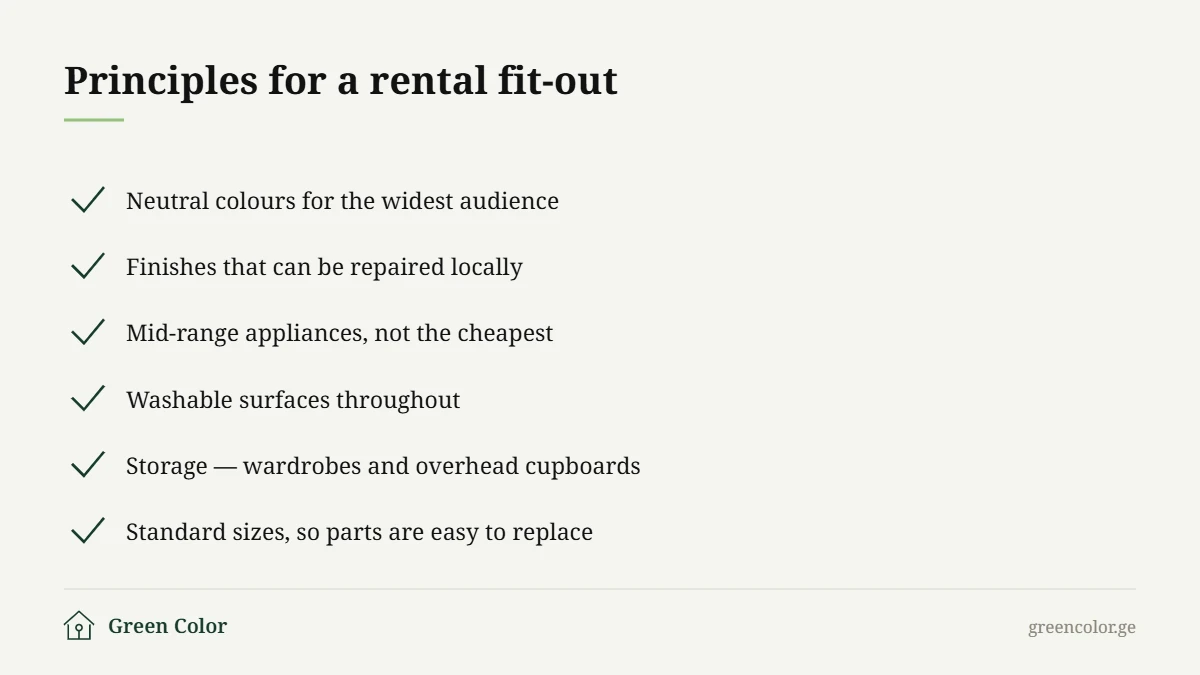
- Neutral colours — your taste is not the market
- Locally repairable finishes — SPC vinyl, where one plank can be swapped
- Mid-range appliances — the cheapest fail within two years and you pay twice
- Washable surfaces — washable paint rather than a matt that marks
- Storage — wardrobes and overhead cupboards genuinely raise rent
- Standard sizes — a non-standard door or fitting becomes a problem at every repair
Calculating the payback
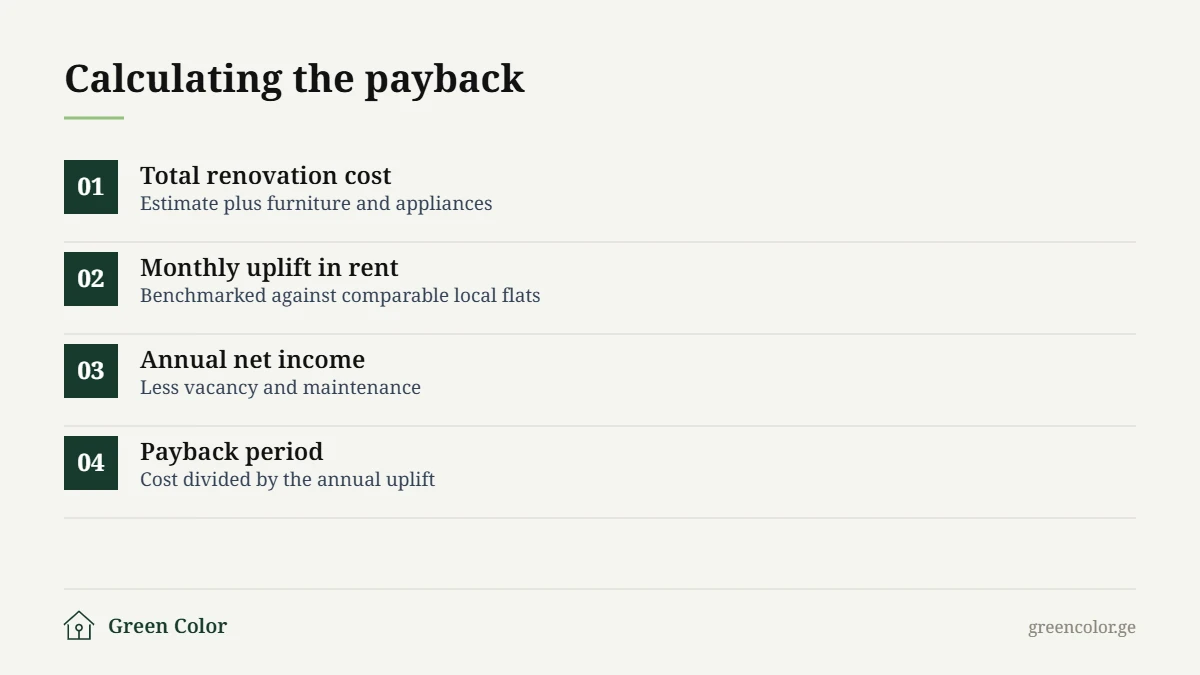
- Total renovation cost — the estimate plus furniture and appliances. Leaving furniture out is the most common error.
- Expected monthly uplift — benchmarked against comparable renovated flats in the same district.
- Annual net income — less vacancy months and maintenance.
- Payback period — total cost divided by the annual net uplift.
If the calculation shows more than seven years, part of the budget is probably going into aesthetics rather than function. That calls for revising the specification, not abandoning the project.
Short-term versus long-term letting
Short-term letting changes the requirements considerably: photogenic interiors, complete equipment, and durability under much higher turnover. Here design genuinely affects income, because the property is sold through photographs.
For long-term letting the opposite holds — minimal maintenance cost and durability dominate. The same apartment should be fitted out differently for the two scenarios, so the decision belongs before the work starts, not after.
Market context and occupancy
Rental property renovation is an investment, so it should be judged on income. Two figures dominate the economics of renting: occupancy, meaning how many months of the year the property is let, and net yield after costs.
Long lets usually deliver high occupancy at a fixed rent. Short lets command far more per night, but occupancy is seasonal and operating costs — cleaning, linen, management — are material. The same renovation therefore produces different results in the two scenarios.
For broader market direction, both construction costs and housing prices are tracked by the National Statistics Office of Georgia.
What actually raises occupancy
In practice a property lets faster not because it is attractive but because it is completely equipped. Tenants compare on specifics: is there a washing machine, a dishwasher, air conditioning in every room, storage, a place to work.
That list is inexpensive relative to what it adds to the rent. A full set of appliances in a rental is almost always a better investment than expensive finishes.
Costs that belong in the calculation
- Vacancy months — realistically one to two per year
- Ongoing repairs and wear items
- Taxes and utilities during vacancy
- Management fees, if you are not managing it yourself
With those four accounted for, rental property renovation produces a real number rather than an optimistic one that collapses in the first year.
Frequently asked questions
Furnished or unfurnished?
In Georgia furnished is the norm and lets considerably faster. The exception is the premium segment, where tenants often bring their own furniture.
How often does it need refreshing?
Cosmetic refresh every four to six years, mostly paint and wear items. Bathroom and kitchen every ten to twelve, assuming they were done properly to begin with.
Is it worth fitting out from frame condition?
Often yes — fitting out from frame usually costs less than reworking an older flat, and needs no intervention for ten years or more.
On market conditions see real estate prices in Georgia, and for budgeting how to estimate renovation costs.