
Table of Contents
Wall Finishes: Paint, Wallpaper or Decorative Plaster
Wall finishes do more than anything else to decide how a finished apartment looks — and depend more than anything else on what lies underneath. The most expensive paint in the world will not hide a badly plastered wall. This guide compares the three main options.
In this article
Three solutions
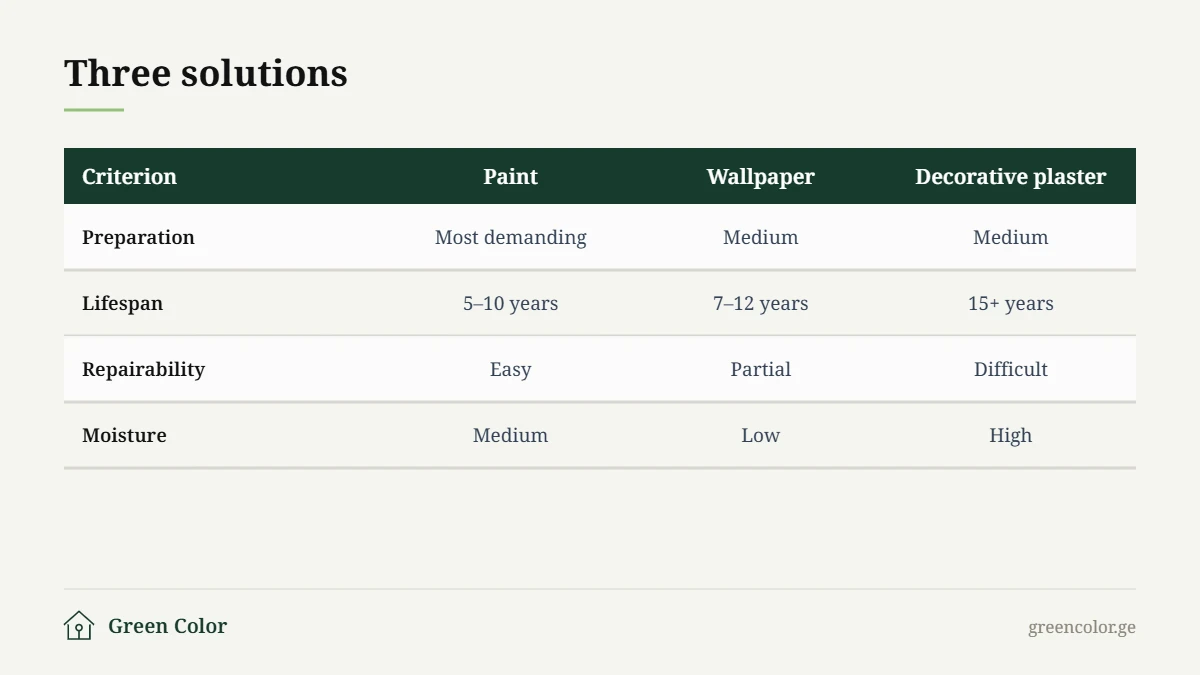
Look at the first row. Paint demands the most preparation because it conceals nothing — every ripple and scratch appears under raking light. Wallpaper, especially textured, covers minor defects, and decorative plaster creates its own relief, which makes it the most forgiving of the three.
Preparation, where half the budget goes
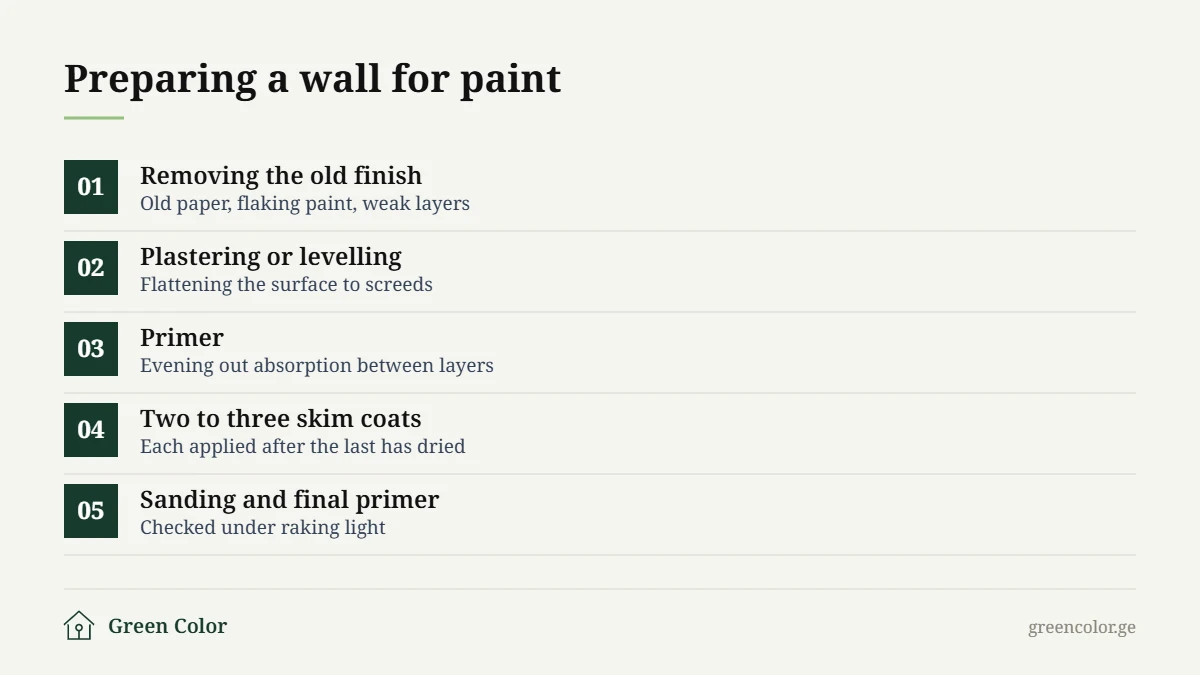
- Removing the old finish — paper, flaking paint, weak layers.
- Plastering or levelling — worked to screeds for a flat plane.
- Primer — to even out absorption between layers.
- Two to three skim coats — each after the previous has dried.
- Sanding and final primer — checked under raking light, not ceiling light.
That last detail separates professional work from amateur: the wall should be inspected with a lamp held parallel to the surface. Under ceiling lighting, ripples are invisible — they appear later, once the furniture and wall lights are in.
What suits which room
Cost
In Georgia, decorating rates run around 25–30 GEL per m² for hanging wallpaper and 25–35 GEL per m² for painting with lining paper. What matters is which area is meant: the decorated surface in an older flat is 3.5–4 times the floor area. In a 70 m² apartment that comes to 250–280 m² of wall.
Expressed against floor area, the averages are 120–180 GEL per m² in an older flat and 100–150 GEL per m² in a green-frame unit.
Wall finishes and substrate preparation
Wall finishes divide into two stages, and the first accounts for around 60% of the cost while remaining entirely invisible. The quality of the plaster and skim determines the final surface — paint only adds colour, and emphasises every defect.
Substrate quality is classified in levels: Q1 technical, Q2 standard for painting, Q3 smooth, Q4 the highest, intended for raking light. Apartments normally use Q2 to Q3, but any wall with a wall light or a large window needs Q4, otherwise every undulation shows.
Agreeing the level in advance matters: “skim coat” in an estimate does not automatically mean Q4, and that ambiguity is where disagreements at handover begin.
Choosing the paint type
Paint selection should follow the function of the room. Matt hides defects better but washes poorly. Eggshell and satin wash well but reveal every ripple. Hallways and children rooms therefore usually call for a compromise — a washable matt.
Damp rooms such as kitchens and areas adjoining a bathroom need paint with anti-mould additives. Ordinary paint there begins to flake within a year or two.
Practical points
- Primer is not optional — it evens out absorption and reduces the number of coats
- Choose the colour on site, not in the shop; lighting changes it dramatically
- Paint a wall in one go without breaks, or you get banding
- Keep leftover paint for touching up contact points
With those four observed, wall finishes hold their appearance for seven to ten years. Without them, redecorating comes round within three.
Frequently asked questions
How many coats of paint are needed?
At least two over primer. For deep colours, or covering over white, three. A single coat almost always finishes patchy.
When is wallpaper the better choice?
When you want texture or pattern, and when you are not confident the wall is perfectly flat. Also as an interim solution in a rental, where surfaces take more wear.
Is decorative plaster expensive?
Per square metre, yes — but it lasts 15 years or more and is less demanding about preparation. Over that period it often works out cheaper, particularly in hallways where surfaces wear fastest.
On colour selection see colour psychology in interior design, and for costs the renovation calculator.