
Table of Contents
How to Estimate Renovation Costs: Building an Accurate Quote
Learning how to estimate renovation cost starts where most conversations end: with actual numbers. When two quotes for the same apartment differ by half, it almost always means they are pricing different amounts of work. This guide covers what the price is made of, how a proper estimate is built, and what to verify before signing.
In this article
Why there is no single price per square metre
“Renovation at $300 per square metre” is marketing, not an estimate. The same 70 m² flat can cost twice as much if partitions and services have to be built from scratch rather than replaced.
There is a second reason. Paintable and tileable areas are much larger than the floor area — roughly 3.5–4 times in an older flat and 2.5–3 times in a green-frame unit. So a rate quoted “per square metre” can mean very different totals depending on which area is being measured. Always ask.
Three ways of pricing
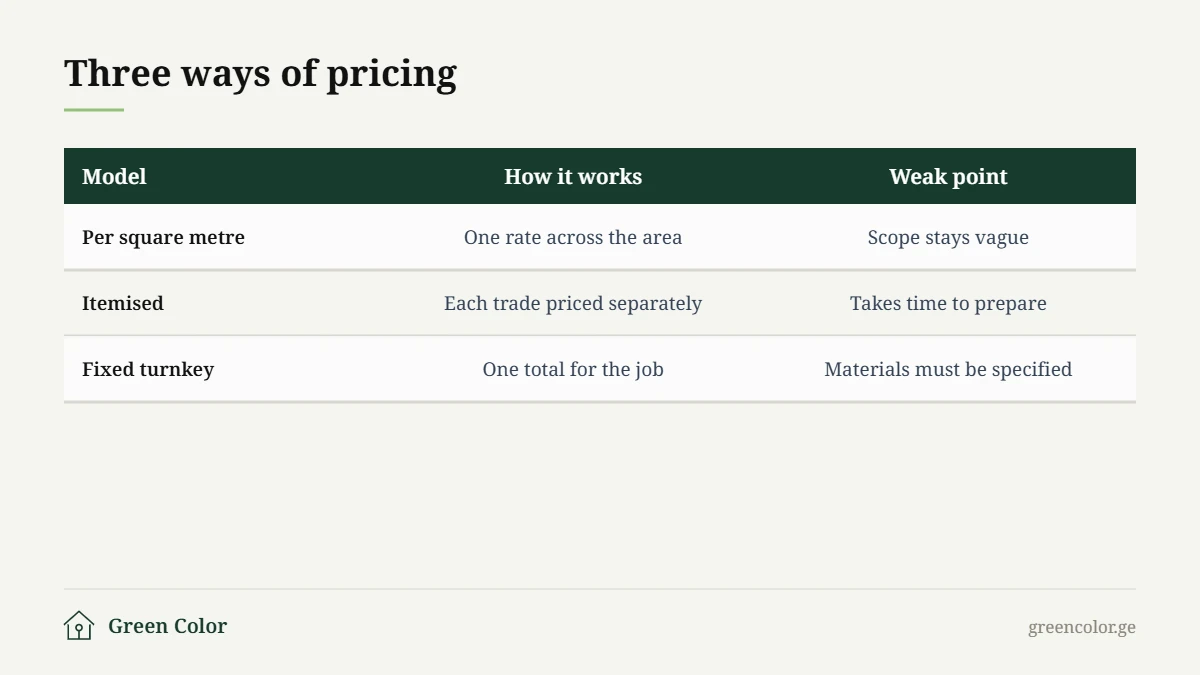
Per square metre
Fine for a first indication, useless as the basis of a contract: it does not show what is included and what is not.
Itemised schedule of works
The correct approach. Every trade is its own line with quantity, unit price and total. An estimate like this can be checked, compared and tracked as work proceeds.
Fixed turnkey price
Convenient, provided the material specification is written into the contract. Without it, material grade quietly drops during execution — and that is where disputes begin.
How an accurate estimate is built
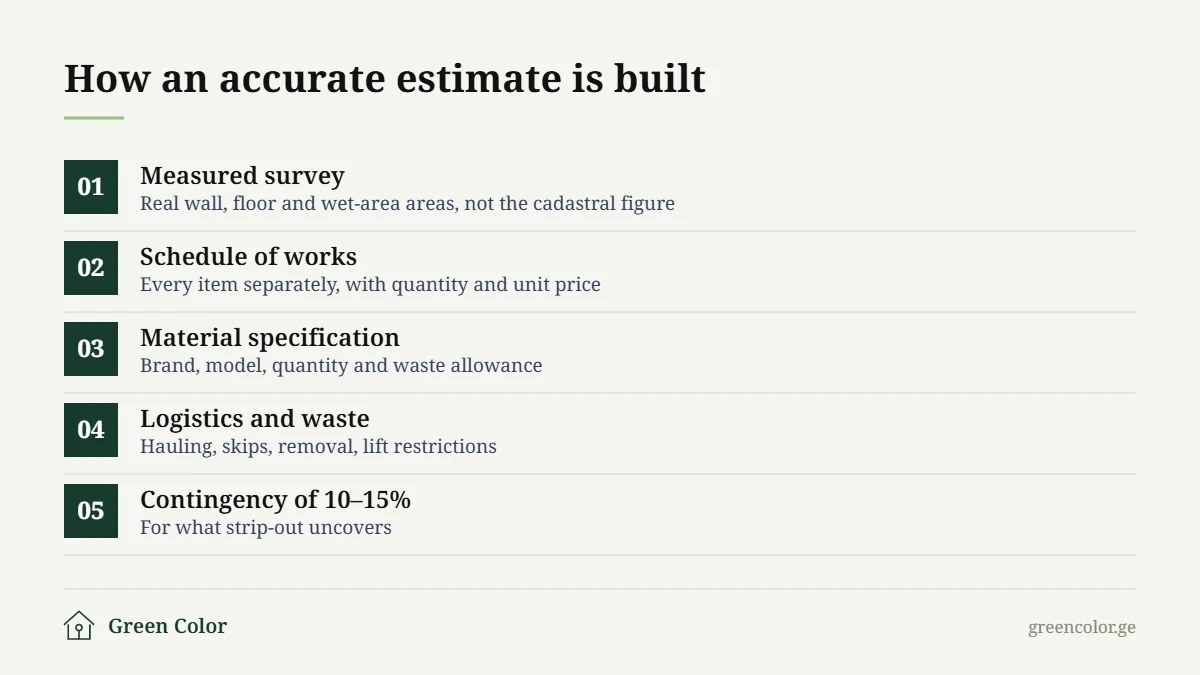
- Measured survey — real areas of walls, floors and wet zones, not the cadastral number.
- Schedule of works — every item separately, with quantity and unit price.
- Material specification — brand, model, quantity and waste allowance (around 10% on tile, 7% on parquet).
- Logistics — hauling, waste removal, skips, lift restrictions. In Tbilisi, getting materials into the flat alone runs 400–1000 GEL.
- Contingency of 10–15% — for what strip-out uncovers.
Budget structure
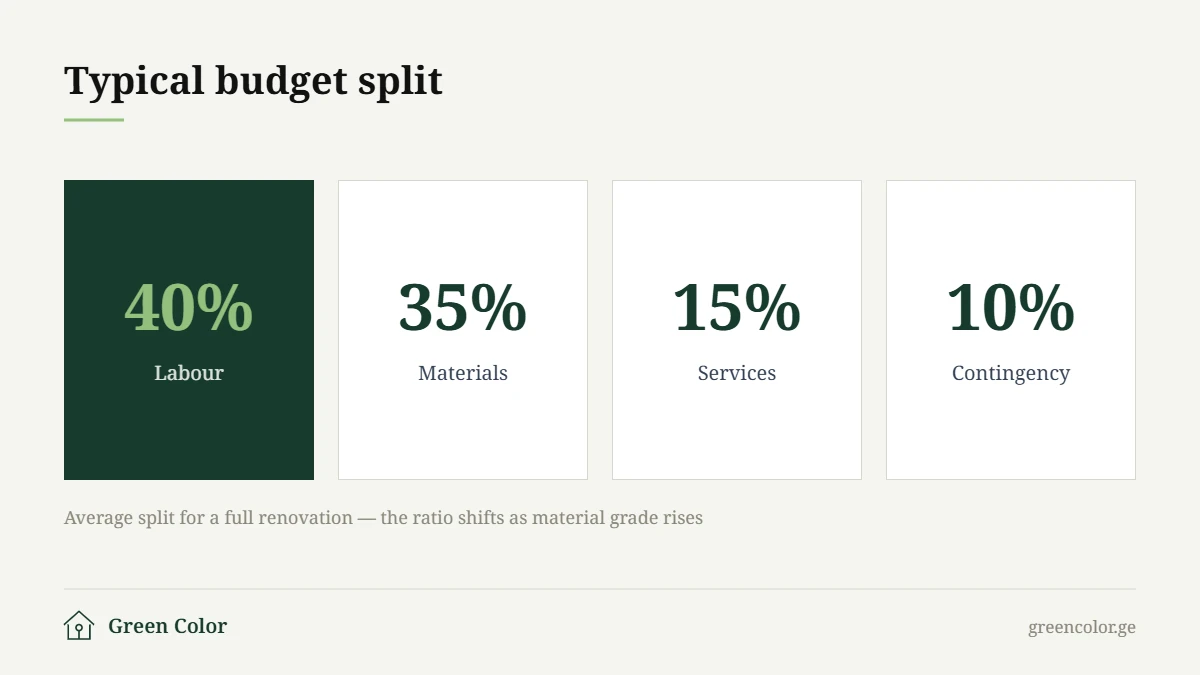
Treat this as a reference point. As material grade rises, materials can reach 50% of the budget while the labour share falls — labour rates do not climb with the price of the tile.
What to check before signing
- Every line has a quantity and a unit price, not just a total
- The document states which works are excluded
- Materials are named by brand and model
- Payments are tied to completed stages, not to dates
- Deadlines and the consequences of delay are written in
- The warranty period and what it covers are stated
Getting a quick figure
For a first indication use the renovation calculator, which returns a range based on area and scope of work. For how prices differ by frame condition, see our guide to black and green frame.
Estimating against a moving market
What makes it hard to estimate renovation cost is that material and labour prices keep moving. The construction cost index published by the National Statistics Office of Georgia tracks that month by month. The practical consequence: an estimate should carry a validity period, normally thirty days.
The second mechanism is fixing the price in the contract. If materials are bought and stored in advance, subsequent price movement no longer affects you. That matters particularly on longer projects running four to six months.
International practice: the itemised schedule
What is called a smeta locally is known internationally as a bill of quantities — a document in which every work item is a separate line with quantity, unit and price. That format is what makes two tenders genuinely comparable.
When a quote arrives as a single total, comparison is impossible: you cannot see whether one contractor is pricing more work or simply taking more margin. For that reason you should always estimate renovation cost at line-item level.
Three questions that test an estimate
- Which works are excluded from this price?
- What happens if additional work is uncovered after strip-out?
- Is the price fixed, or does it follow the materials market?
If you get a clear written answer to all three, the estimate is probably real. If any of them closes with “we will see”, the number is not final yet.
Frequently asked questions
Why is one quote half the price?
Usually because it prices less work — skim coating instead of full plastering, or partial rather than complete rewiring. Compare line items, not totals.
Who should buy the materials?
Either works. What matters is that the specification is agreed in advance; once it is, the purchaser makes little difference.
How accurate is a preliminary figure?
Before a survey, about ±25%. After a survey and design project, ±5–10%. That is why the contract should follow the design project, not precede it.
Want a detailed, line-by-line estimate? Get in touch — the survey and estimate are free of charge.