
Table of Contents
Renovation in Tbilisi: Districts, Costs and What to Check
Renovation in Tbilisi means two very different projects depending on where you buy. In the older stock of Vake and Saburtalo the challenge is strip-out and worn-out services; in the new towers of Ortachala, Isani and Didi Dighomi it is building everything from bare concrete. This guide covers how the two differ, what timelines and costs are realistic, and the local requirements that never appear in a quote.
In this article
Old stock or new build
This is the first question, and it determines both budget and timeline.
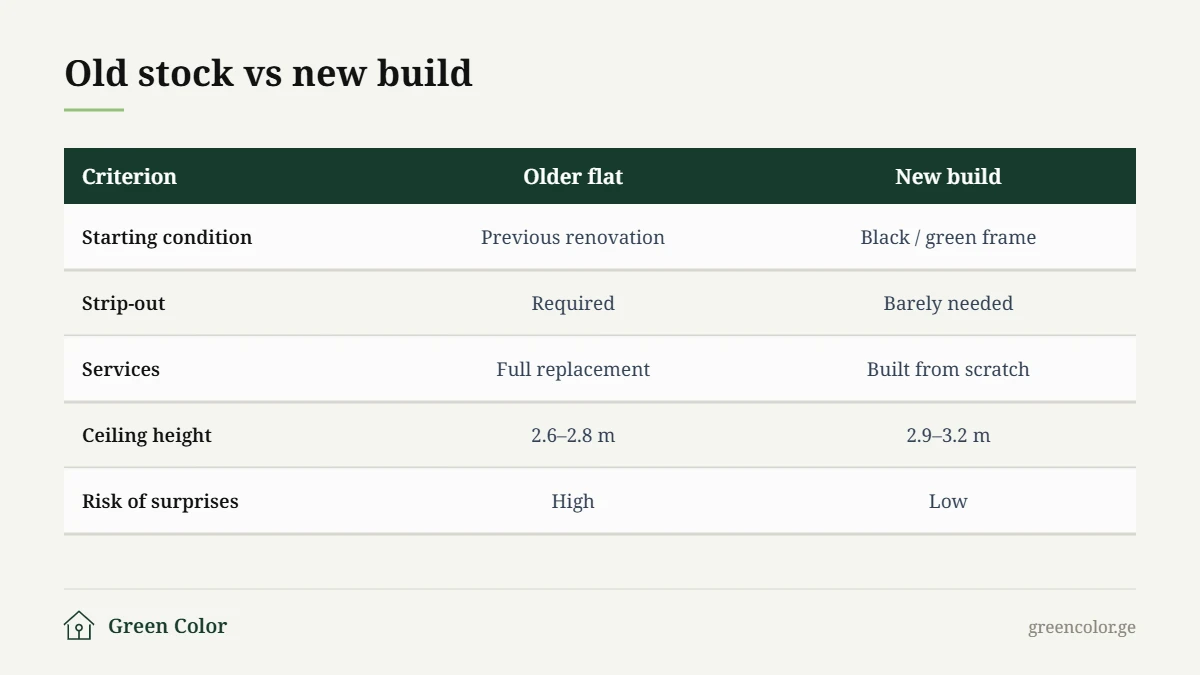
In an older flat the main risk is what you find after strip-out: corroded pipes, floors out of level, or an electrical supply that cannot carry modern appliances. That is why an estimate for older stock should always carry a 10–15% contingency.
A new build is far more predictable, but the volume of work is larger. Apartments are sold as black or green frame, and fitting out a black-frame unit means partitions, plastering and every service from zero.
Districts and what they mean for the work
Vake and Vera
Mostly older stock, often with high ceilings and non-standard layouts. A design project matters more here than anywhere else, because standard solutions simply do not fit. Our projects in the area: Ateni Street, Ramishvili Street.
Saburtalo
Mixed stock — Soviet-era blocks alongside new construction. The most common request is combining the kitchen and living room. Examples: Jikia Street, Sairme Street, Tamarashvili Street.
Ortachala and Isani
Mainly new high-rise buildings with panoramic views, fitted out from frame condition, so the whole project is planned up front: 14th floor, 22nd floor, 23rd floor.
Didi Dighomi, Vashlijvari, Temka
The most affordable segment, with large volumes of new construction. Budget optimisation matters most here: Vashlijvari.
How long renovation takes in Tbilisi
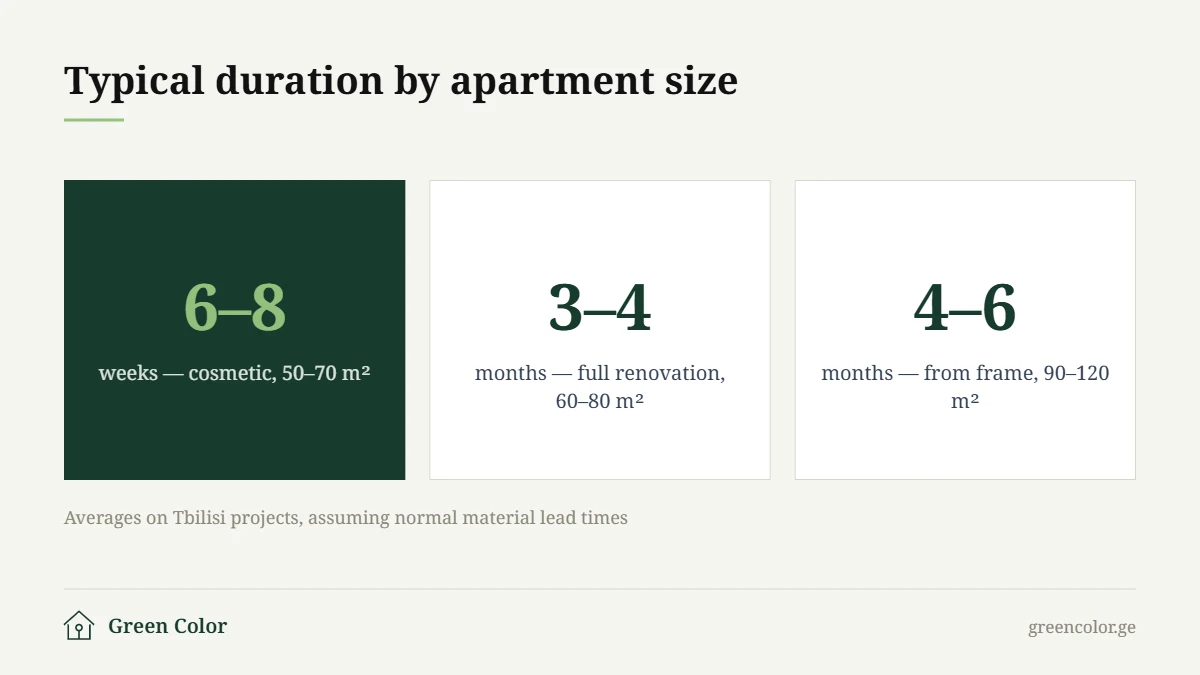
These assume a normal schedule. The usual cause of delay is not the trades but decisions: choosing tiles or flooring late stops the whole chain. Material selection should be finished before strip-out begins.
Local requirements
These never appear in an estimate but shape the process:
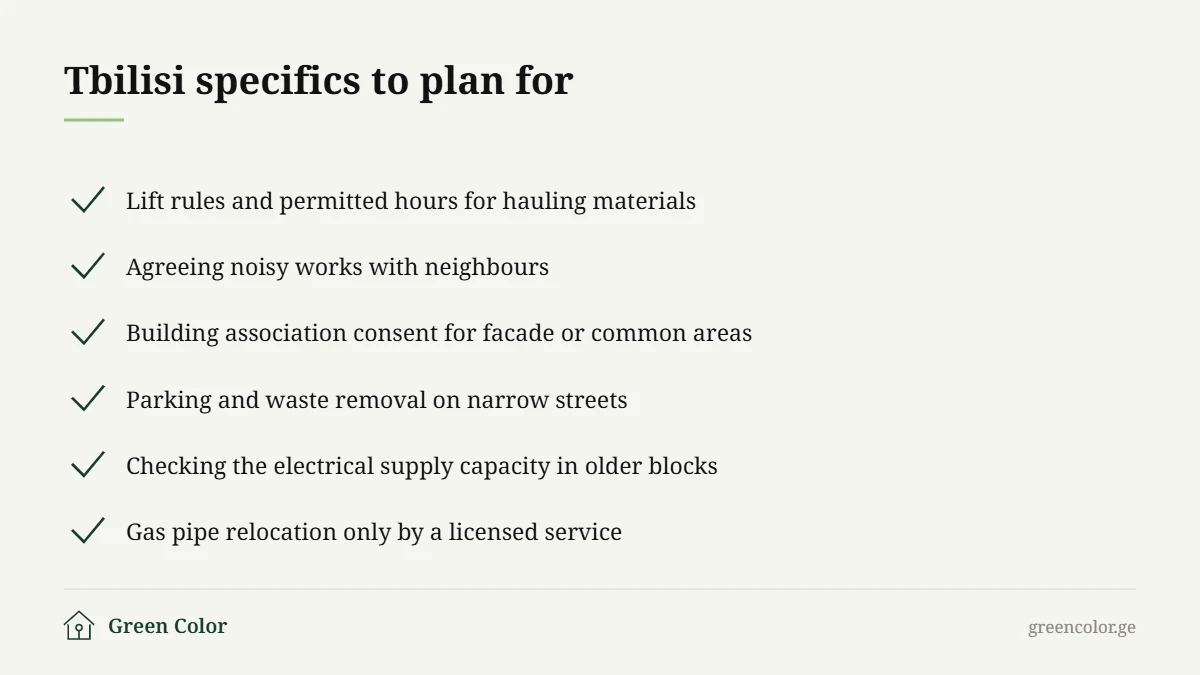
- Lift rules — many new buildings allow materials to be brought up only at set hours
- Agreement with neighbours on noisy work, particularly in older blocks
- Building association consent where the facade or common areas are affected
- Parking and waste-removal logistics on narrow streets
- Checking the electrical supply capacity in older flats
- Any gas pipe relocation strictly through a licensed service
Working out the price
Labour in Tbilisi is the most expensive in Georgia, but the difference between districts is minimal — the price is set by the condition of the flat and the scope of work, not the address. For a figure on your own property, use the renovation calculator.
The state of the Tbilisi market
Renovation in Tbilisi tracks the pace of new construction. The construction cost index published by the National Statistics Office of Georgia has climbed steadily, driven largely by wages and logistics rather than material prices alone.
The practical consequence for an owner is simple: a price quoted today will probably not hold in six months. An estimate should therefore carry a validity period, and the contract should fix the price — otherwise the difference comes out of your pocket.
Specific risks in the older housing stock
Three things surface most often after strip-out in older Tbilisi buildings: corroded risers, inadequate electrical supply, and floors well out of level. All three can be assessed in advance if the survey is done seriously, which is why an estimate produced without a site visit should not be accepted.
Structural walls are a separate matter. Before any partition is removed it must be confirmed that it is not load-bearing. Facade changes, balcony glazing and extensions require permits; current regulations are published on the Legislative Herald of Georgia.
What this means for the budget
- A 15% contingency in older stock, not 10%
- Riser replacement agreed with the building association, ideally with neighbours
- Upgrading the electrical supply is a separate process and adds to the programme
- Levelling the floor with screed — frequently omitted from estimates
When renovation in Tbilisi is planned in an older apartment, these four items belong in the budget from the outset. Remembering them later always costs more.
Frequently asked questions
Do I need a permit to renovate in Tbilisi?
Interior work that does not touch load-bearing structures needs no permit. Moving partitions requires confirmation that the wall is not load-bearing. Changing the facade or glazing a balcony falls under separate regulation.
Can I live in the flat during the work?
During a cosmetic refresh, yes, zone by zone. During a full renovation, realistically no — dust, noise and disconnected services make it impractical.
Can the project be run while I am abroad?
Yes, with a project manager acting as client representative and scheduled photo and video reporting. Most of our overseas clients work this way.
Want an itemised estimate for your apartment? Get in touch — the survey and estimate are free.