
Table of Contents
Renovation in Georgia: Costs, Stages and Choosing a Contractor
Renovation in Georgia has changed considerably in recent years. Material costs have risen, a large stock of new-build apartments has appeared, and buyers — many of them foreign owners and investors — now expect clear budgets and firm deadlines. This guide covers what you need to know before work begins: realistic prices per square metre, the correct order of works, how to plan a budget and how to pick a contractor.
In this article
What renovation costs in Georgia in 2026
There is no single price per square metre. The figure you end up with is the sum of individual trades. The table below shows the items that appear in almost every project, in Georgian lari, materials and labour included.
| Work | Older flat | Green frame |
|---|---|---|
| Final wall plastering | 100–120 ₾/m² | 100–120 ₾/m² |
| Electrical rewiring | 25–30 ₾/m² | 25–30 ₾/m² |
| Painting | 120–180 ₾/m² | 100–150 ₾/m² |
| Wallpapering | 25–30 ₾/m² | 20–25 ₾/m² |
| Plumbing point | 10–15 ₾/point | 10–15 ₾/point |
| Hauling materials into the flat | 400–1000 ₾ (one-off) | 400–1000 ₾ (one-off) |
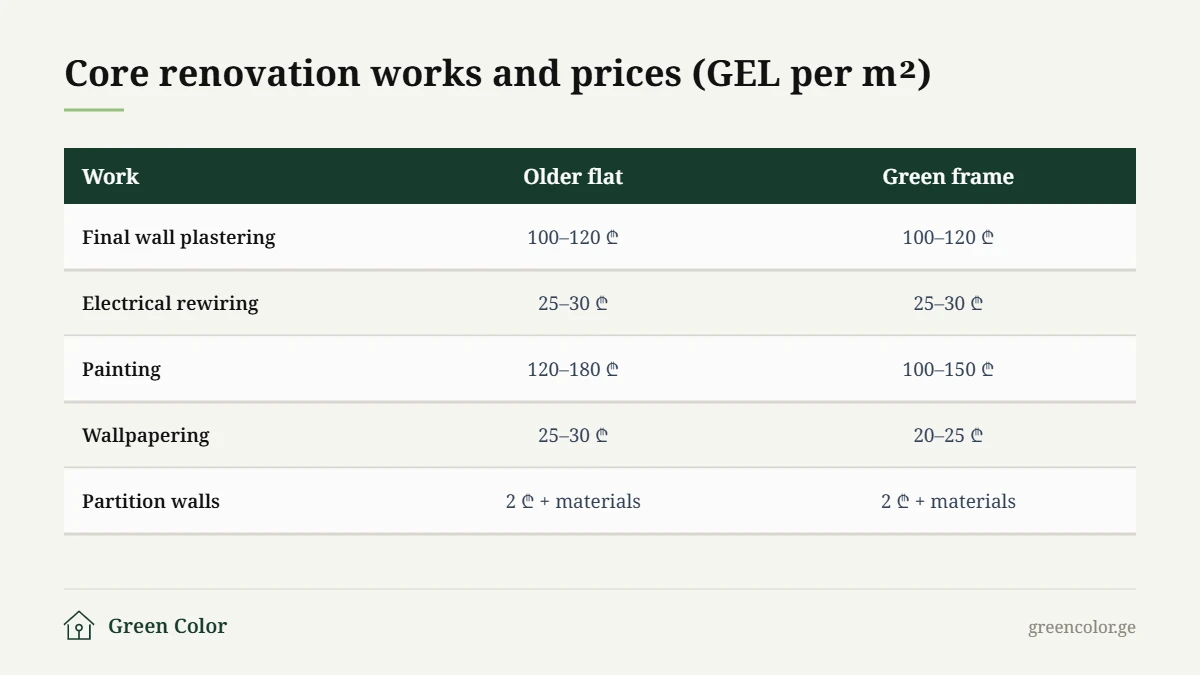
One detail catches most people out: the paintable surface area is far larger than the floor area — roughly 3.5–4 times in an older flat and 2.5–3 times in a green-frame unit. A quoted rate “per square metre” therefore multiplies up quickly, so always confirm which area the contractor is measuring.
Regional differences: Tbilisi, Batumi and the regions
Labour is most expensive in Tbilisi, where new construction and demand are concentrated. Batumi is strongly seasonal — crews are booked through the summer and rates rise, while autumn and winter leave far more room to negotiate. In the regions labour runs roughly 15–25% cheaper, though transporting materials claws back part of the saving.
Types of renovation
Cosmetic renovation
Surface work only: painting, wallpaper, new flooring, replacing sanitary fittings. Engineering services are left untouched, so it is the quickest and cheapest option.
Full renovation
Moving partitions, complete replacement of electrics and plumbing, plastering and full finishing. This is the usual choice in the older housing stock.
Renovation from frame condition
New-build apartments in Georgia are sold as “black frame” or “green frame”. Black frame means bare concrete: partitions, services and plastering all have to be built from scratch, and that is where the biggest share of the budget goes.
The order of works, step by step
Getting the sequence wrong is the most expensive mistake there is, because it usually means tearing out finished work. The correct order looks like this:
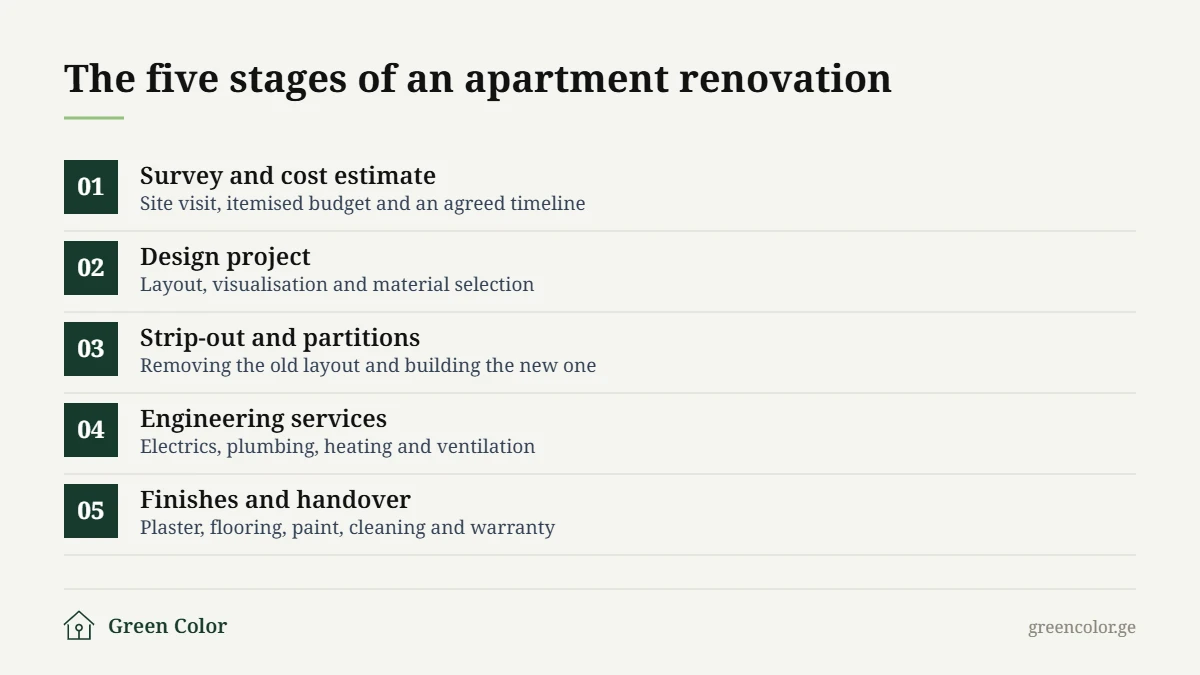
- Survey and cost estimate — site visit, itemised budget, agreed timeline.
- Design project — layout, visualisation, material selection.
- Strip-out and partitions — removing the old layout, building the new one.
- Engineering services — electrics, plumbing, heating, ventilation.
- Finishes and handover — plaster, flooring, paint, cleaning, warranty.
Planning the budget
A practical rule: add 10–15% on top of the estimate as a contingency. In an older building, stripping out almost always uncovers something — a corroded pipe, a floor that is out of level, an undersized electrical supply. Without a contingency, a discovery like that stops the project.
The second rule: tie payments to completed stages rather than to the calendar. You can get an indicative figure for your own flat in a few seconds with the renovation calculator.
Choosing a renovation company
For foreign owners the recurring problem is not price but fragmented responsibility: a separate tradesman, a separate designer, a separate supplier — and nobody accountable for the result. If you are not in the country while the work runs, a single point of responsibility matters more than a slightly lower quote. Here is the minimum to require:
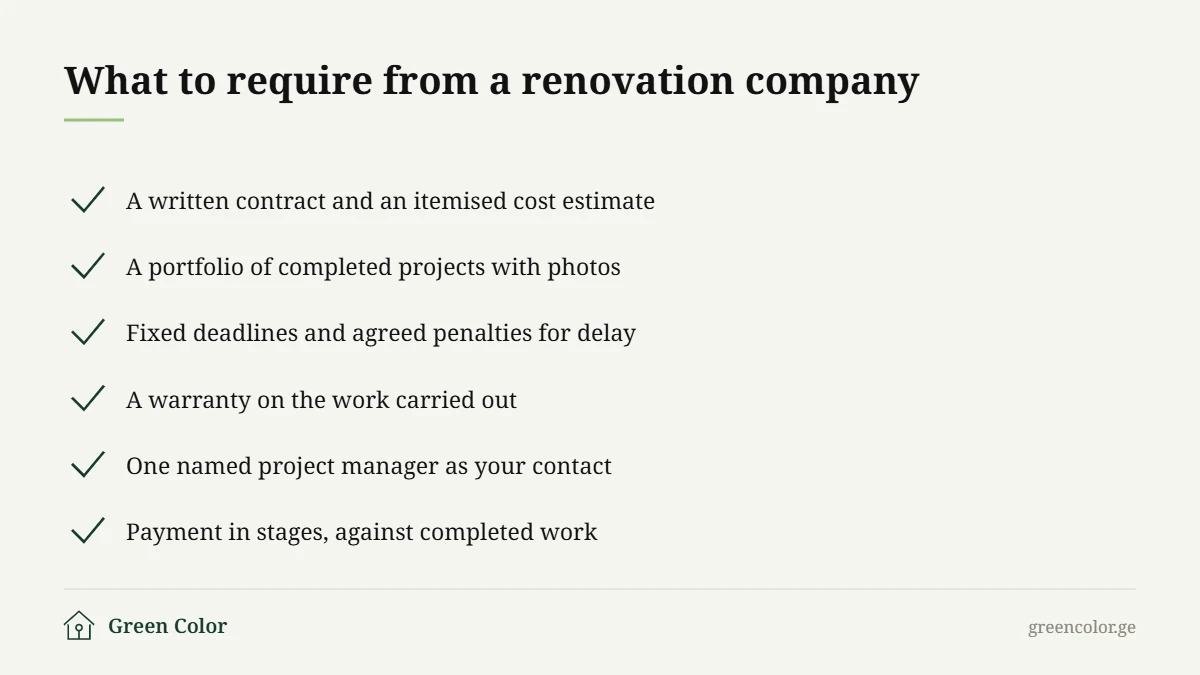
- A written contract and an itemised, line-by-line cost estimate
- A portfolio of completed projects, ideally in comparable buildings
- Fixed deadlines and agreed consequences for delay
- A warranty on the work carried out
- One named project manager coordinating the process
- Payment in stages, after work is completed and inspected
You can see our completed projects on the projects page, and the full list of what we do here.
What has changed in renovation in Georgia
Over the past five years, renovation in Georgia has shifted in three directions. The first is material cost: the construction cost index published by the National Statistics Office of Georgia has risen steadily, and that feeds straight into every estimate.
The second is the sheer volume of new-build stock. Most apartments handed over in Tbilisi and Batumi are sold as black or green frame, which means the buyer inherits a renovation project automatically. A decade ago that segment was far smaller.
The third is client expectation. Renovation used to be judged almost entirely on price; today buyers are equally demanding about deadlines, contracts and warranties. That shift is what created the market for full project management, where one company carries responsibility for the entire cycle.
Permits and regulations
Interior work needs no permit in Georgia provided it does not touch load-bearing structures. That caveat matters: before any partition comes down, it must be confirmed that the wall is not structural. Permits are required for facade alterations, balcony glazing, extensions that increase floor area, and any intervention in load-bearing elements. Gas pipework may only be altered by a licensed contractor.
Current legislation is published on the Legislative Herald of Georgia, though specific requirements should always be verified against the development plan of the relevant municipality. For foreign owners this is worth delegating — the documentation is in Georgian and the municipal processes are not always intuitive.
What to check with the building association
- Permitted hours for noisy work
- Rules and restrictions on using the lift for materials
- Obligations to protect and clean common areas
- Where and when construction waste may be removed
None of these appear in an estimate, yet they shape the programme. In our experience, renovation in Georgia is delayed more often by these organisational details than by any shortage of trades.
Frequently asked questions
How long does an apartment renovation take?
A full renovation of a standard 60–80 m² flat from frame condition takes three to five months on average. A cosmetic refresh takes three to six weeks. The biggest variables are material lead times and how quickly decisions get made.
Do I need a design project?
Especially if the budget is tight. A design project does not add to the cost — it prevents reworking, which is far more expensive.
Can the work be managed remotely?
Yes, provided there is a project manager acting as the client representative, with scheduled photo and video reporting and stage-based sign-off. That is how most of our overseas clients run their projects.
Want a figure for your own apartment? Get in touch — we will survey the property and prepare a detailed, itemised estimate at no cost.