
Table of Contents
Energy-Efficient Renovation: Insulation and Lower Bills
An energy-efficient renovation in Georgia usually gets reduced to replacing the windows — which is both the most expensive step and not the most effective one. Most heat escapes through walls, not glazing. This guide covers where heat is actually lost and which measures pay for themselves fastest.
In this article
Where heat escapes
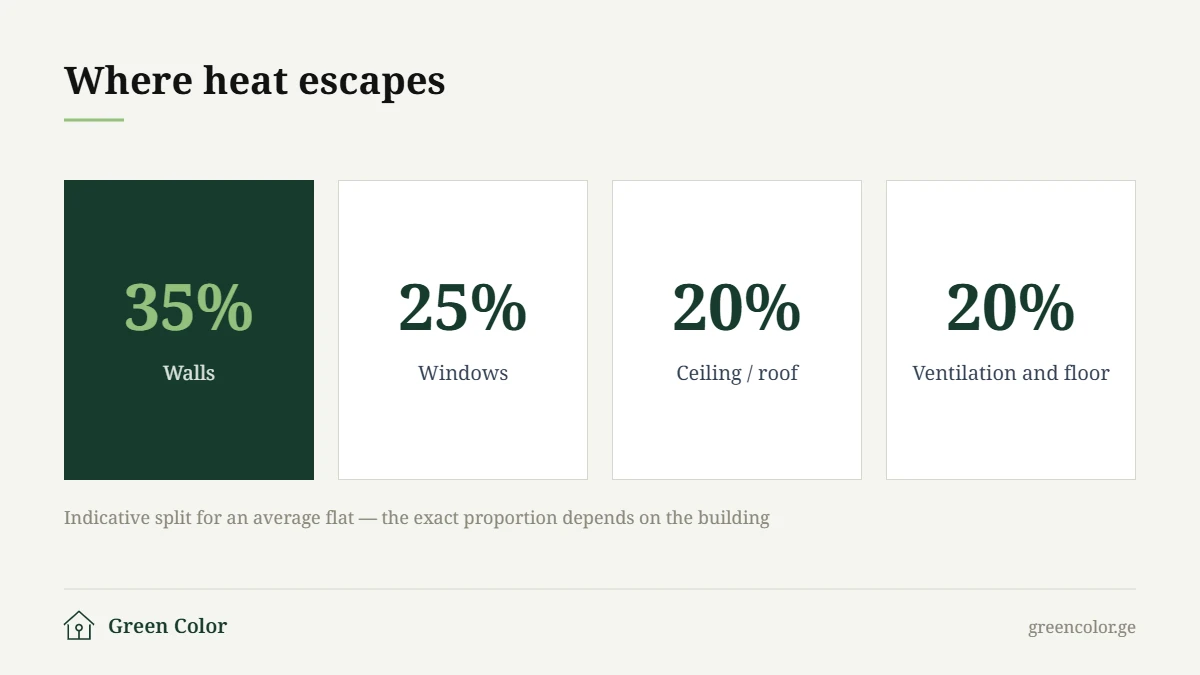
Treat these as indicative — the real picture depends on the building. In a corner flat the wall share rises; on a top floor the ceiling does. That is why proper energy work starts by establishing where your losses are, rather than following general advice.
Which measures pay back
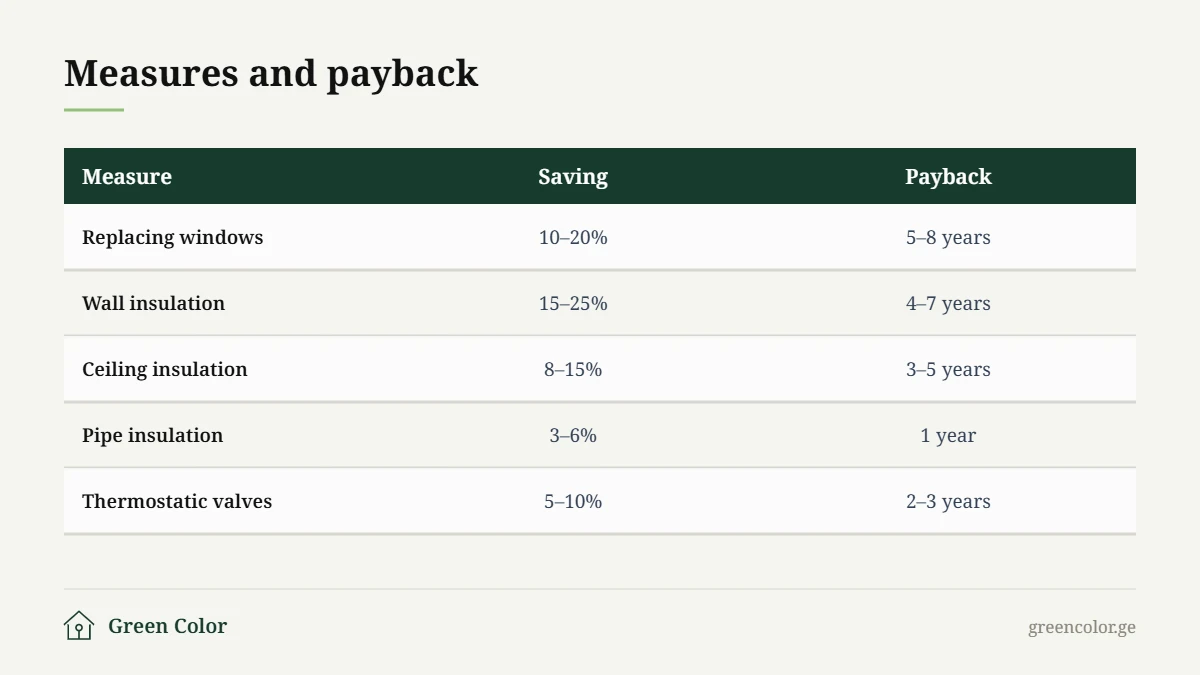
The fastest payback belongs to the cheapest measures. Insulating pipework pays for itself within a season, thermostatic valves within two or three. Replacing windows involves the largest outlay and the longest payback, though its effect on comfort is the most noticeable.
Wall insulation: outside or inside
External insulation is technically correct: the wall stays within the warm zone and condensation does not form inside it. In a multi-unit building, however, it requires a decision by the owners association and facade consent.
Internal insulation is easier but riskier. If the vapour barrier is installed incorrectly, moisture collects between the insulation and the wall and mould becomes a certainty. With internal insulation the vapour barrier and detailing at junctions are mandatory — this is not where to economise on materials.
Cheap steps that work immediately
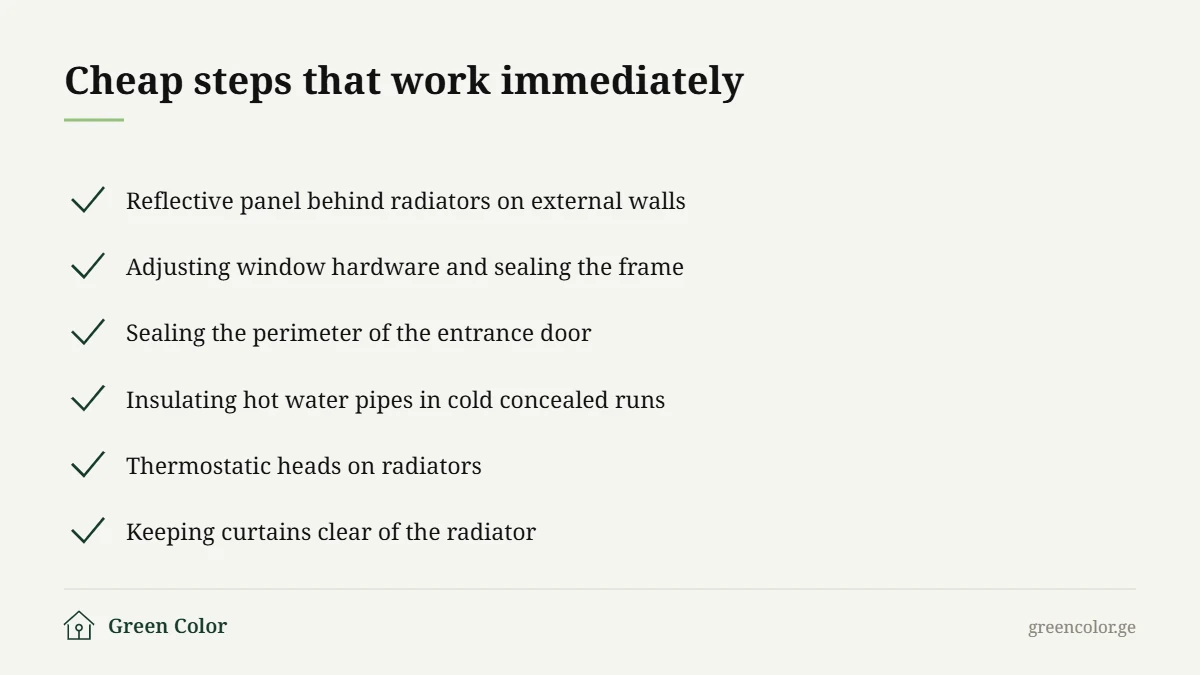
- A reflective panel behind radiators, particularly on external walls
- Adjusting window hardware and resealing the frame — often you do not need new windows at all
- Sealing the perimeter of the entrance door
- Insulating hot water pipes in cold concealed runs
- Thermostatic heads on radiators, so rooms are controlled separately
- Keeping curtains clear of the radiator, or the heat goes straight to the glass
The ventilation paradox
Airtight windows retain heat but also stop air exchange. The result is rising humidity, condensation on the glass and mould in the corners. The answer is heat-recovery ventilation or, at minimum, trickle vents in the window frames, which admit air without losing much warmth.
The physics behind insulation
An energy efficient renovation rests on one physical principle: heat always moves from warm to cold, and the greater the resistance in its path, the less you lose. The effectiveness of thermal insulation is simply a measure of that resistance.
The practical consequence is that doubling the thickness does not halve the loss. The first 5 cm delivers the largest share of the benefit, the second 5 cm considerably less. In many cases thin insulation across three surfaces beats thick insulation on one.
The second principle is thermal bridging — points where insulation is interrupted: balcony slabs, window reveals, corners. Heat escapes through these in concentrated fashion, and they are exactly where condensation and mould appear in winter. Continuity of insulation matters more than its thickness.
Where to start: an audit
Before doing anything, it is worth establishing where heat is actually lost in your specific apartment. The simplest method is thermographic imaging — a thermal camera on a cold day shows which surfaces are coldest.
That single procedure often changes the whole plan. Many owners arrive intending to replace the windows, and the thermography shows the real losses are at the north wall and the balcony slab.
Order of priority
- Draught-proofing — cheapest, immediately noticeable
- Ceiling or roof on a top floor
- North-facing and corner walls
- Windows last, once everything else is done
That order is sorted by payback. An energy efficient renovation that begins with windows spends the most money over the longest period.
Frequently asked questions
How much do heating bills actually fall?
With a combined approach — walls, ceiling, windows and sealing together — real savings run 30–40%. Individual measures deliver considerably less, because the heat simply leaves by another route.
Is underfloor heating worth it?
In efficiency terms yes: it runs at lower temperatures and distributes heat evenly. But the benefit only materialises if there is insulation beneath it — otherwise you are heating the flat below.
When should this work be done?
Alongside a renovation, when insulation can be planned together with services and needs no additional strip-out. Doing it separately costs 1.5 to 2 times as much for the same work.
For private houses see construction in Georgia, and for heating systems our guide to heating installation in an old apartment.